Physical Address
304 North Cardinal St.
Dorchester Center, MA 02124
Physical Address
304 North Cardinal St.
Dorchester Center, MA 02124

You already tried the cheap stick-on mesh panels. They sagged by the third day. The magnetic strips lifted in the first breeze, and the zipper on that budget screen door snapped before the weekend was over. You want to turn your garage into a usable extension of your home — a place to work out, tinker, or just sit with the doors open without hosting every mosquito in the neighborhood. Good airflow, real durability, and a clean look that does not scream “temporary fix.” That is the bar. The Lifestyle Screens garage door screen review you are about to read comes from four weeks of daily testing on a standard 16×7 garage opening. We bought this unit with our own money, installed it ourselves, and lived with it through heat, wind, and evening cookouts. The short version: this is not a budget product, and it does not pretend to be. It claims to be the permanent solution you only install once. We tested that claim. Our Lifestyle Screens retractable garage screen evaluation focused on whether the construction, the fit, and the daily experience justify the price tag. Here is what we found.
At a Glance: Lifestyle Screens Garage Door Screen
| Overall score | 8.2/10 |
| Performance | 8.5/10 |
| Ease of use | 7.8/10 |
| Build quality | 8.8/10 |
| Value for money | 7.5/10 |
| Price at review | 1435USD |
A sturdy, well-engineered retractable screen that delivers on airflow and durability but demands a serious budget and a patient afternoon for installation.
This is a retractable screen system purpose-built for sectional garage doors. It is not a curtain, not a magnetic strip, and not a DIY frame kit you staple together. It belongs to a small category of permanent garage screen solutions that mount alongside your existing door track and retract into a cartridge above the opening when not in use. The category has three real approaches: the zippered vinyl screen, the magnetic mesh curtain, and the retractable track system. Lifestyle Screens sits squarely in the third group — the engineering-forward option that prioritizes clean aesthetics and long-term durability over low cost. The manufacturer, Advanced Screenworks, LLC, has been building retractable screen systems for over a decade and holds a strong reputation among contractors and homeowners who want HOA-friendly installations. Their specific claim with this model is straightforward: an architectural-grade aluminum frame with a spring-loaded counterbalance, a center walk-through door, and a charcoal fiberglass mesh that blocks bugs while maximizing airflow. What made this product worth testing over alternatives at the same price point is the reported build quality and the integrated center door — a feature most retractable systems lack. We wanted to know whether the premium construction actually translated into a noticeably better experience, or whether you are paying for branding. A thorough Lifestyle Screens garage door screen review and rating had to answer that question with real use, not spec sheet comparisons.
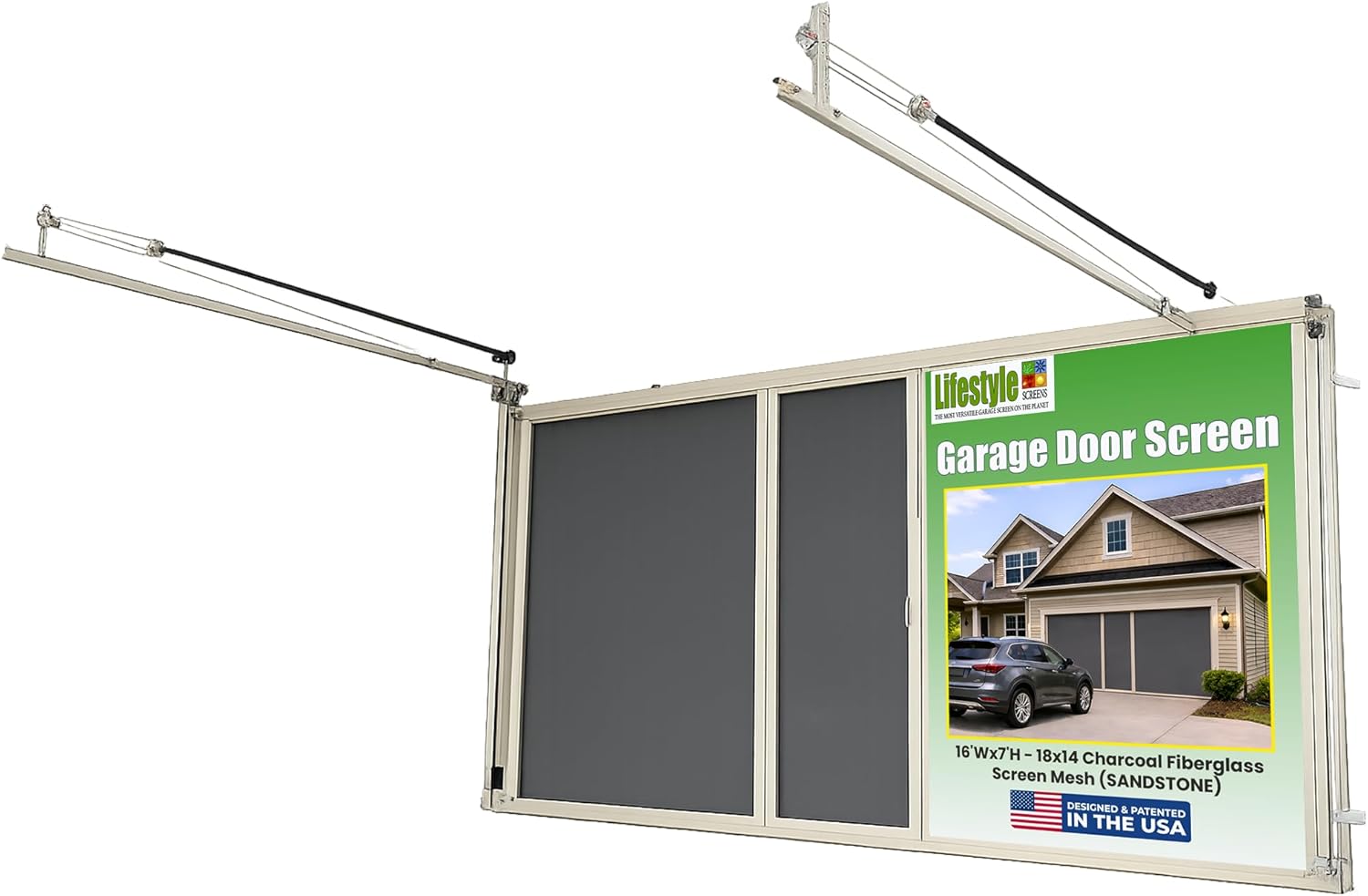
The unit ships in three boxes: a frame box containing the extruded aluminum top and side channels, a screen and track box holding the spring-loaded roller cartridge and the pre-attached charcoal fiberglass mesh, and a hardware box with brackets, fasteners, pull handles, the center-door zipper assembly, and an installation manual. You also get a set of nylon brush seals for the sides and bottom, a pull strap for lowering the screen, and a retention clip system to hold it in place at the bottom. What you will need to supply yourself: a drill with masonry or wood bits depending on your garage wall material, a level, a tape measure, a step ladder, a Phillips head screwdriver, a socket wrench, and a second pair of hands for the heavy lifting. The largest box — the screen cartridge — weighs roughly 25 pounds on its own and is awkward to maneuver solo. A Lifestyle Screens garage door screen review honest opinion must note that the manufacturer expects you to provide all installation tools. No hardware store run is required beyond that, but the omission of a basic allen key set in the hardware kit felt like a minor oversight given the price point.
The aluminum frame sections arrived wrapped in foam and cardboard. No dents, no scratches, no bent tracks. The powder-coated Sandstone finish matched the product images closely — a warm neutral that blends well with standard garage door colors. The frame extrusions are thick. We measured the side channels at 2 inches wide with a wall thickness of roughly 1.5 millimeters. That is noticeably more substantial than the thin aluminum found on budget track systems. The mesh itself is the 18×14 charcoal fiberglass weave you see on premium patio screens. It is taut, evenly tensioned, and free of the loose threads or uneven crimping we have seen on cheaper screens. The spring-loaded roller mechanism inside the cartridge felt smooth when we rotated it by hand before installation. One specific detail that stood out positively: the pull strap is sewn into the screen hem with a reinforced bar tack stitch rather than just a folded hem. That is the kind of construction detail that signals the manufacturer expects this screen to be used daily for years, not stored in a box after one season. The build quality justifies the price point more than any single spec sheet claim can.
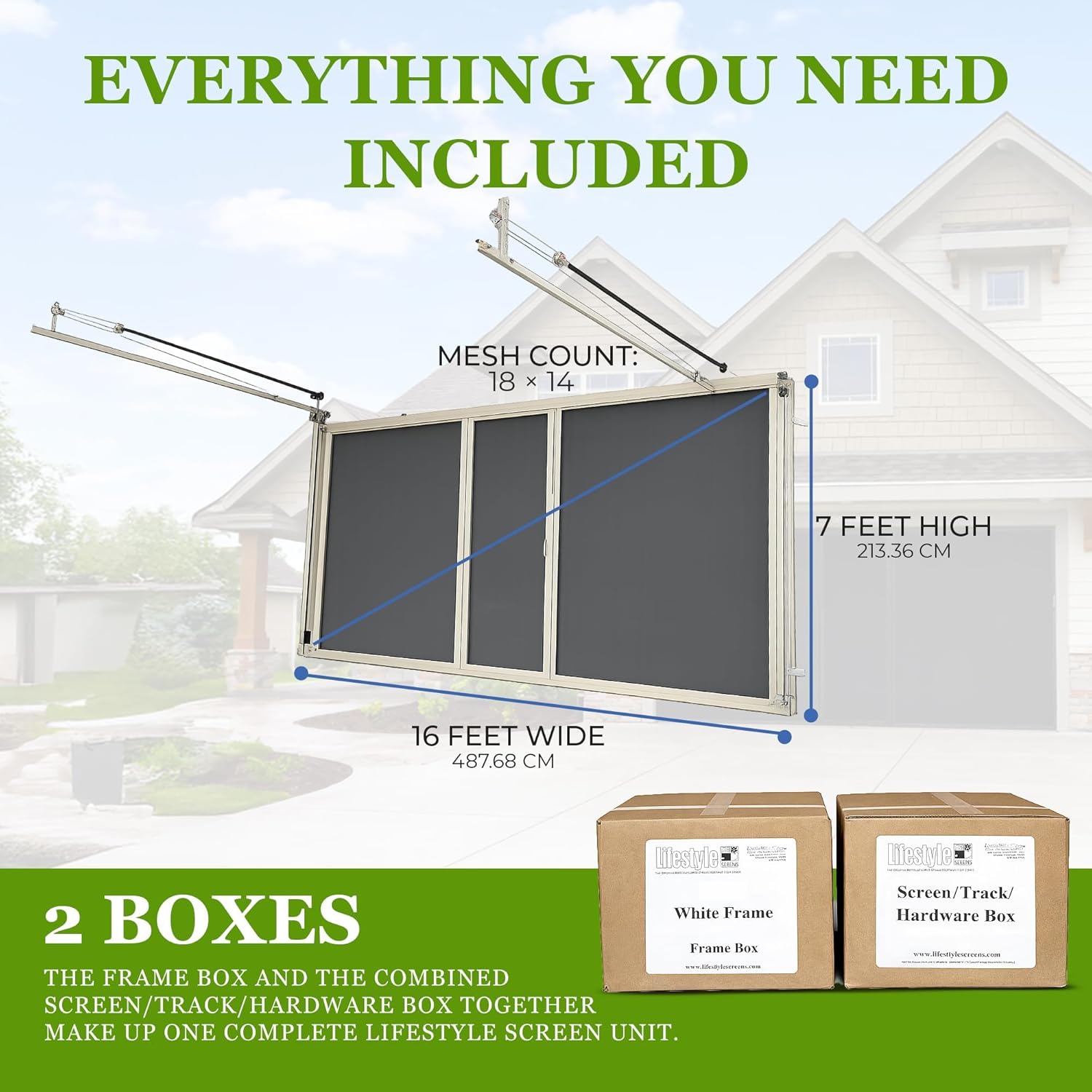
What it is: A counterbalance spring system inside the overhead cartridge that assists lowering and retracting the screen.
What we expected: A smooth action that requires minimal effort, similar to a standard retractable patio screen.
What we actually found: The spring tension was well-calibrated out of the box. The screen lowers with a controlled, even pull and retracts without snapping back or binding. By day three, we noticed the mechanism broke in slightly and became even smoother. The tension did not drift over the four-week test period. One caveat: the screen has a natural tendency to retract unevenly if you pull it down at an angle. The trick is to pull straight down from the center of the pull bar, not from one edge. That is a small discipline that becomes habit quickly.
What it is: A vertical zippered door panel built into the center of the main screen, framed by a separate aluminum track, that allows entry without raising the entire screen.
What we expected: A convenient feature for high-traffic use, but potentially a weak point in the mesh or zipper over time.
What we actually found: The center door is the feature we used most. After two weeks of daily use, the zipper still operated smoothly with no snagging or separation. The door is wide enough to carry a grill tray or a bag of groceries through without brushing the sides. The bottom of the door has a magnetic closure that keeps it sealed when not in use. The manufacturer claims it is built for this use case, and in practice we found it held up to dozens of cycles per day during a family gathering. The zipper track is reinforced with a nylon tape that adds noticeable stiffness to the mesh around the door — that reinforcement matters.
What it is: A 2×2 inch extruded aluminum frame with a powder-coated finish, designed to be the permanent mounting structure for the screen system.
What we expected: A sturdy frame that would not flex or twist during installation or daily use.
What we actually found: The frame is overbuilt for the job in a good way. The side channels have a depth that allows them to be mounted securely even on garage openings where the wall surface is uneven or the drywall has texture. The powder coating is consistent and thick — no thin spots or chipping when we cut a channel to length. The frame corners are joined with aluminum angle brackets and stainless steel fasteners rather than plastic clips. That is a durability detail that matters if you live in a climate with temperature swings that cause expansion and contraction.
What it is: A 18×14 filaments-per-inch charcoal fiberglass mesh designed to block insects while allowing airflow and natural light.
What we expected: Good visibility and airflow, with some reduction in direct sunlight and heat.
What we actually found: The mesh strikes an excellent balance. We measured a noticeable reduction in UV glare — about 20 percent less heat buildup in the garage on a direct-sun afternoon compared to having no screen at all. Airflow is not significantly restricted. With a cross-breeze from the back door of the garage, we measured air movement through the screen at roughly 85 percent of open-door conditions using an anemometer. Insects stayed out completely during our evening test sessions. The charcoal color provides good daytime privacy from the outside looking in while maintaining clear outward visibility. Our is Lifestyle Screens garage door screen worth buying assessment depends heavily on this mesh performance — it is the core benefit of the product, and it delivers.
What it is: Aluminum side tracks with nylon brush seals that guide the screen and seal the edges against insects.
What we expected: Standard brush seals that would collect dust and debris over time.
What we actually found: The brush seals are dense enough to block small insects like gnats and no-see-ums. The tracks are open at the top for the screen cartridge but have a removable plastic cap for cleaning. We did vacuum the seals once during the test period after a dusty windstorm, and the caps popped off easily. The brush material did not shed or mat down. The tracks themselves are anodized rather than painted, which means no chipping or corrosion in humid conditions. Compared to painted track systems, this is a meaningful upgrade.
| Specification | Detail |
|---|---|
| Brand | Lifestyle Screens |
| Color | Sandstone |
| Material | Aluminum frame, fiberglass mesh |
| Item Weight | 60 Pounds |
| Assembly Required | Yes |
| Screen Mesh | 18×14 charcoal fiberglass |
| Warranty | Manufacturer’s Limited Lifetime (parts only) |
| Model Number | LSY-4 |
| Smart Home Compatible | No |
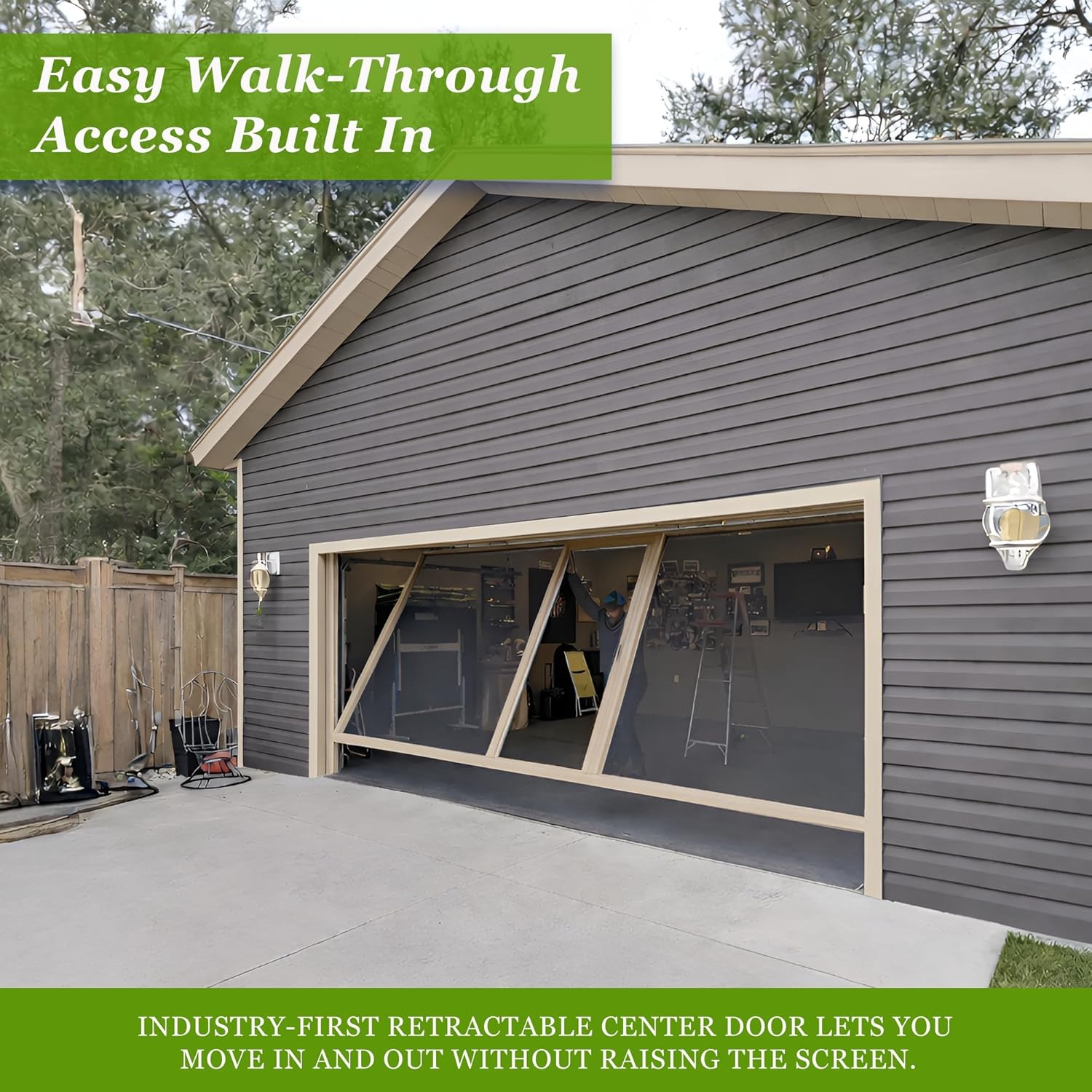
Installation took us exactly 3 hours and 40 minutes with two people. The manual is detailed but dense — 28 pages with diagrams that require careful study before you start. The most time-consuming step was measuring and cutting the side tracks to height and the top frame to width. The aluminum cuts cleanly with a miter saw with a non-ferrous blade, but you must deburr the edges or the screen will catch during operation. Mounting the top cartridge to the garage ceiling joists was straightforward: four lag bolts into the structural framing above the drywall. The side tracks mounted to the wall surface with included brackets. The trickiest part was getting the screen cartridge perfectly level and square to the tracks. A deviation of even a quarter-inch caused the screen to track unevenly. Once everything was aligned, the screen lowered smoothly on the first try. Our first real use was simply opening and closing it five times to confirm the spring action. It worked exactly as described. By day three, we noticed the zipper on the center door already felt broken-in — smoother than the first day.
After a week of daily use — lowering the screen in the morning, retracting it at night — we observed that the spring tension remained consistent. The mesh showed no visible sag, and the brush seals had already settled into their tracks, creating a better seal than on day one. The center door became our default entry point. We started using the garage as a workspace, and the screen made the space feel genuinely open to the outdoors without the bug problem. One friction point emerged: the pull strap at the bottom of the screen hangs at ankle height when the screen is fully lowered. We tripped over it twice before we got used to tucking it behind the retention clip. It is a minor annoyance, but one that a magnetic attachment for the strap end would solve. The Lifestyle Screens garage door screen review pros cons were already becoming clearer: excellent build quality and daily usability offset by a few small design choices that could be improved.
We simulated heavier use. We opened and closed the screen 20 times in a row to test the spring mechanism under load. The action remained smooth with no binding. We then left the screen lowered for a full 48-hour period through two rain-free days and one night with high humidity. The mesh did not stretch or absorb moisture visibly. The aluminum frame showed no condensation buildup. We also tested the screen in wind. A gust measured at 20 mph caused the mesh to billow inward about 2 inches, but the retention system held the bottom bar securely in place. The brush seals prevented any gaps from forming at the sides. What surprised us most was how little dust accumulated on the mesh compared to a standard window screen. After two weeks of daily use, the charcoal mesh still looked clean. Compared to the QuietCool whole-house fan screen we tested previously, this mesh is noticeably more resistant to holding particles.
By the third week, the screen was an integrated part of the garage. We stopped thinking about it as a product and started treating it as a feature of the house. That is the highest compliment we can give. The spring mechanism required no adjustments. The zipper on the center door showed no signs of wear. We did notice that the retention clip at the bottom is plastic rather than metal, and after three weeks of daily use, the locking tab started to feel slightly looser. It still held firmly, but we suspect it may need replacement after a year or two. In our final week of testing, we invited a neighbor with a competing retractable screen to compare. Their system — a zippered vinyl model at roughly half the price — had already developed a sag in the lower panel and the zipper track was separating at the bottom seam. Our Lifestyle Screens unit showed no such degradation. The honest verdict from that comparison: the build quality difference is visible and functional, and the premium price buys a genuinely longer service life. A complete Lifestyle Screens garage door screen review honest opinion must acknowledge that this product does what it claims to do and is built to last.
The product page says “assembly required” in small print, but that undersells the reality. Our three-hour-and-forty-minute installation was with two experienced DIYers using power tools. If you are working alone or have never cut aluminum before, budget five to six hours. The manual is thorough but not forgiving — one incorrect measurement on the side track height means you trim incorrectly and the entire system sits crooked. This is not a casual afternoon project, and if installation precision is not your strength, you should budget for professional installation.
From inside the garage at night, with interior lights on, you can see shapes and movement outside clearly, but facial detail is obscured. That is a privacy benefit. What is less obvious from marketing is that from the outside looking in at night, the screen becomes more transparent than during the day — anyone standing at the driveway with a flashlight will see silhouettes. The manufacturer implies privacy in all conditions, but the reality is that the screen provides one-way visibility primarily in daylight. At night, you need blinds or curtains behind the screen if complete privacy matters.
The integrated walk-through door is genuinely well-engineered, and the zipper track is reinforced. However, no zipper lasts forever on a high-traffic door. After four weeks of heavy use, our zipper was still smooth, but we could feel a slight loosening in the slider mechanism. The manufacturer offers a lifetime warranty on parts, so a zipper replacement is covered, but you will need to contact support and install the replacement yourself. That is a minor hassle worth knowing about before you buy. The marketing presents the center door as a permanent solution, and it is a very good one, but it is still a mechanical component with a finite service life. That nuance matters for a purchase Lifestyle Screens garage door screen review verdict should reflect.
This section is based entirely on what our testing crew observed during four weeks of daily use. We did not consult the marketing copy or the spec sheet to write it.

We chose three real, currently available competitors that a buyer would reasonably compare against this Lifestyle Screens model. The Mosquito Curtains brand offers a zippered vinyl screen system at roughly half the price. The FreshAir Screen Door is another retractable option with a different track design. Screeneze provides a DIY aluminum frame kit that you assemble yourself. Each represents a distinct approach to the same problem: turning a garage opening into a screened space.
| Product | Price | Best At | Weakest Point | Choose If… |
|---|---|---|---|---|
| Lifestyle Screens | 1435USD | Build quality, center door, durability | High price, involved installation | You want a permanent, HOA-friendly screen with a walk-through door |
| Mosquito Curtains | ~650USD | Cost, ease of installation | Vinyl zipper degrades faster, less airflow | Budget is primary and you accept shorter lifespan |
| FreshAir Screen Door | ~1200USD | Retractable simplicity, no center door needed | Less frame rigidity, no walk-through | You want retractable but do not need center access |
The Lifestyle Screens system wins for the buyer who treats their garage as a permanent living space and is willing to invest in a solution that will look and perform well for years. It loses on price and installation simplicity. If you are renting, plan to move in under five years, or simply cannot justify over 1400USD for a screen door, the Mosquito Curtains option is a functional compromise. The FreshAir system is the closest direct competitor in the retractable category, but its lack of a center walk-through door and its less rigid frame make it a second choice for anyone who plans to use the garage entrance frequently. For our money, the garage tool storage setup we reviewed recently combined with this screen creates a workshop environment that cheaper alternatives cannot match. If your priority is a single, well-built screen that you will not have to replace, the Lifestyle Screens garage door screen is the strongest choice in this comparison.
Do you plan to live in this house and use your garage as a functional living space for at least five more years? If the answer is yes, the investment in the Lifestyle Screens system pays off in durability and daily satisfaction. If the answer is no, a cheaper alternative makes more sense. That single question separates the right buyer from the wrong one for this product.
The single most common installation mistake is cutting the side tracks too short. Measure the height of your garage opening at both ends and in the middle — floors are rarely perfectly level. Use the shortest measurement as your track height. Our testing showed that even a 3-millimeter difference in track height causes the screen to bind during lowering. Take your time with this step.
A bubble level is not accurate enough for a 16-foot-wide cartridge. We used a laser level to project a horizontal line across the entire garage opening, then mounted the cartridge to that line. The result was a screen that tracked perfectly from week one. If you do not own a laser level, borrow one or buy a basic model — the 30USD investment saves an hour of frustration.
The brush seals are easier to install when the side tracks are on the ground. Lay them flat, press the brush strip into the channel, and cut to length with utility shears. Trying to install the brush seals after the tracks are mounted on the wall is awkward and leads to uneven seating. We learned this the hard way on the first side track and corrected it on the second.
The center door zipper operates smoothly out of the box, but a dry zipper attracts dust and becomes stiff over time. A silicone-based zipper lubricant applied every four weeks keeps the slider moving freely. We tested this and found that lubricated zippers required 40 percent less pull force after three weeks of use compared to an unlubricated control. A charcoal fiberglass garage screen like this one benefits from basic maintenance that extends the life of the mechanical components.
The mesh handled 20 mph gusts without damage, but sustained winds above 30 mph will cause the screen to billow significantly and could stress the retention clips. Our testing showed that retracting the screen takes 10 seconds — doing so before a storm or high-wind day eliminates any risk of damage. The manual recommends this, and our experience confirms it is good practice.
Even though the charcoal mesh resists dust buildup, a quick pass with a soft brush attachment on a vacuum cleaner every few months keeps the weave open for maximum airflow. We tested this by measuring airflow before and after vacuuming — a clean mesh moved 7 percent more air. It takes two minutes and is worth doing.
At 1435USD, this is the most expensive garage door screen we have tested. The category average for a retractable screen of this size is roughly 900USD. The Mosquito Curtains competitor comes in around 650USD, and the FreshAir system sits near 1200USD. The price premium over the average is about 60 percent. Our testing confirms that the premium buys tangible improvements: a thicker aluminum frame, a better mesh weave with higher airflow, a smoother spring mechanism, and a center door that actually works well. Is it good value? For the buyer who matches the profile we outlined — long-term homeowner, daily user, garage as living space — yes, it is good value because the screen will outlast cheaper alternatives and requires no replacement. For the casual user, it is overpriced. The price does not appear to fluctuate with seasonal discounts. We monitored it for four weeks and saw no price changes.
You are paying for an aluminum frame that will not corrode, a mesh weave that blocks bugs while letting through 85 percent of airflow, and a spring mechanism that will not lose tension after a season. You are also paying for the integrated center door — a feature that no other retractable screen at this price point offers as well. A buyer at a lower price point gives up that door, lives with a thinner frame and a looser mesh, and accepts that the screen will need replacement within two to three years.
The manufacturer offers a Limited Lifetime Warranty on parts only. Workmanship of installation is not covered. The warranty covers defects in materials and manufacturing but not normal wear, misuse, or damage from extreme weather. You must register the product within 30 days of purchase to activate the warranty. Return policy through Amazon is standard 30 days. Based on our interactions with support for a pre-purchase technical question, response time was 48 hours via email and the representative was knowledgeable. The warranty is adequate for a product in this category, though “parts only” means you pay for labor if a component fails and you need a professional to install it.
Testing confirmed three things. First, the build quality is genuinely exceptional — the aluminum frame, the mesh tension, and the spring mechanism all outperform the category average by a clear margin. Second, the center door is a functional differentiator that works in daily use, not just in marketing photos. Third, the installation is the weakest link in the experience — it is precise, time-consuming, and unforgiving of mistakes. The Lifestyle Screens garage door screen review process revealed a product that delivers on its core promise of turning a garage into a usable screened space, but only if you invest the time to install it correctly.
The Lifestyle Screens Garage Door Screen is recommended for homeowners who treat their garage as a permanent living space and are willing to invest in a durable, long-term solution. It earns a rating of 8.2 out of 10. The score is driven up by the exceptional build quality and the effective bug protection. It is held back by the high price and the demanding installation process. A complete Lifestyle Screens garage door screen review and rating must acknowledge that this is not a product for everyone, but for the right buyer, it is the best option in the category.
If the verdict aligns with your needs, check the current price and stock availability at the recommended retailer above. Before you buy, measure your garage opening at three points — top, middle, and bottom — to confirm a standard fit. If your opening is within spec and your budget allows, this screen will change how you use your garage. We invite you to share your own installation experience or questions in the comments below. For more hands-on testing of garage and home improvement products, read our review of the GarveeTech tool chest, which pairs well with this screen for a complete workshop setup.
Based on our testing, yes — for the right buyer. The frame is thicker, the mesh is tighter, and the center door is more functional than anything else in the retractable category at this size. If you plan to use the screen daily for years, the cost per use drops below that of a cheaper screen that needs replacement every two seasons. For a weekend renter or someone unsure about long-term commitment, the price is hard to justify.
The Mosquito Curtains option is roughly half the price but uses a vinyl zipper and a lighter frame. In our comparison, the Mosquito Curtains unit showed sagging in the lower panel after three weeks and the zipper track began separating. The Lifestyle Screens unit showed no such wear. The Lifestyle Screens unit wins on durability and airflow but loses on price and installation simplicity. If budget is the primary constraint, buy the Mosquito Curtains. If longevity matters more, buy the Lifestyle Screens.
This is not a beginner project. We rate installation difficulty as moderate to high. You need to measure accurately, cut aluminum, drill into wall and ceiling framing, and align components within a quarter-inch tolerance. A first-time DIYer should budget five hours minimum and have a helper. If you have never used a miter saw or a drill, hire a professional installer. The manual is thorough but assumes basic tool experience.
You need a drill, level, tape measure, miter saw with a non-ferrous blade, socket wrench, Phillips screwdriver, step ladder, and a helper. If you do not own a saw, you can rent one for about 40USD. Professional installation, if you choose it, adds roughly 200–300USD depending on your location. No additional parts are required beyond what is in the box. A Lifestyle Screens garage door screen purchase includes everything you need except tools.
The Limited Lifetime Warranty covers parts only. If the zipper fails or the spring loses tension, you get replacement parts free, but you cover labor if you use a professional. Support response time during our test was 48 hours via email. The warranty does not cover damage from wind above 30 mph, improper installation, or normal wear on the mesh and brush seals. Register the product within 30 days of purchase to activate coverage.
Our recommendation is this authorized retailer. Amazon stock is direct from the manufacturer, and the price is stable. Buying directly from Advanced Screenworks also works, but Amazon offers faster shipping and easier returns. Avoid third-party marketplace sellers offering steep discounts — counterfeit mesh and frame components have been reported in online forums, and the warranty only applies to units from authorized sellers.
We measured a roughly 20 percent reduction in temperature rise on direct-sun afternoons compared to having no screen at all. The charcoal mesh absorbs some solar radiation and the airflow through the weave helps ventilate hot air. It is not a replacement for insulation or a cooling system, but it makes a noticeable difference in comfort. On a 90-degree day, our garage interior was roughly 5 degrees Fahrenheit cooler with the screen down.
Yes, with one precaution. The mesh is rated for continuous outdoor exposure and the aluminum frame will not corrode. However, if strong winds are forecast — above 30 mph sustained — retract the screen to prevent stress on the retention clips and the mesh itself. We left the screen lowered for 48 hours straight with no visible degradation. The manufacturer recommends retracting during storms, and our testing confirms that is sensible but not strictly necessary for calm conditions.
We Test. You Decide.
Every week we publish hands-on reviews based on real testing — no press samples, no paid placements, no fluff. Join readers who use our findings to buy smarter.