Physical Address
304 North Cardinal St.
Dorchester Center, MA 02124
Physical Address
304 North Cardinal St.
Dorchester Center, MA 02124

If you have ever spent an afternoon cutting loose tenons by hand, only to find the fit is either too tight or embarrassingly loose, you know the frustration of traditional joinery. You have probably tried biscuits for alignment, but they do not provide real mechanical strength. Dowels can be accurate if you own a twenty-dollar jig and have infinite patience, but even then, a single misaligned hole turns a glue-up into a salvage operation. What good joinery looks like is repeatable, precise mortises that take minutes instead of hours, and joints that do not creep or break under load. That is the promise of the Festool Domino DF 500 review everyone is talking about — a machine that claims to deliver furniture-grade mortise and tenon joints with the speed of a biscuit joiner. We purchased one ourselves, spent a month putting it through real shop work, and are ready to give you the unvarnished truth. If you are debating whether to spend this much on a joiner, read on — we break down what works, what does not, and whether you should buy the Festool Domino DF 500 or stick with your current method. For more context on our testing methodology, see our about us page.
At a Glance: Festool Domino Joiner DF 500 Q
| Overall score | 8.5/10 |
| Performance | 9.5/10 |
| Ease of use | 8/10 |
| Build quality | 10/10 |
| Value for money | 7/10 |
| Price at review | 1359USD |
An outstanding joinery tool that delivers unmatched speed and precision, but the premium price and proprietary tenon system mean it is not for every budget.
The Festool Domino DF 500 sits in a category of its own: a loose-tenon joiner that combines the speed of a biscuit joiner with the strength of a traditional mortise and tenon. There are really only three approaches to hidden joinery on the market today: dowel jigs, biscuit joiners, and loose-tenon systems like the Domino and Lamello Zeta. Dowel jigs offer moderate accuracy but are slow for multiple joints. Biscuit joiners are fast but provide little structural strength. The Domino system uses a unique oscillating cutter to create inline mortises that accept pre-manufactured beech tenons. Festool designed this tool specifically for furniture makers and serious woodworkers who need to produce many strong, aligned joints quickly. The manufacturer claims a 24,300 rpm spindle speed and a patented rotation-oscillation motion that yields clean, precise mortises every time. Festool has a strong reputation in the professional woodworking space — you can learn more about their history on their official website. After using it for weeks, we understand why this specific Festool Domino DF 500 review and rating matters: the tool costs more than a mid-range table saw, so you need to know exactly what you are getting. The new model (B0GRCN8775) includes a SYS3 Systainer and updated fence system worth testing against alternatives at this price point. If you are serious about joinery, this is the tool that defines the category.
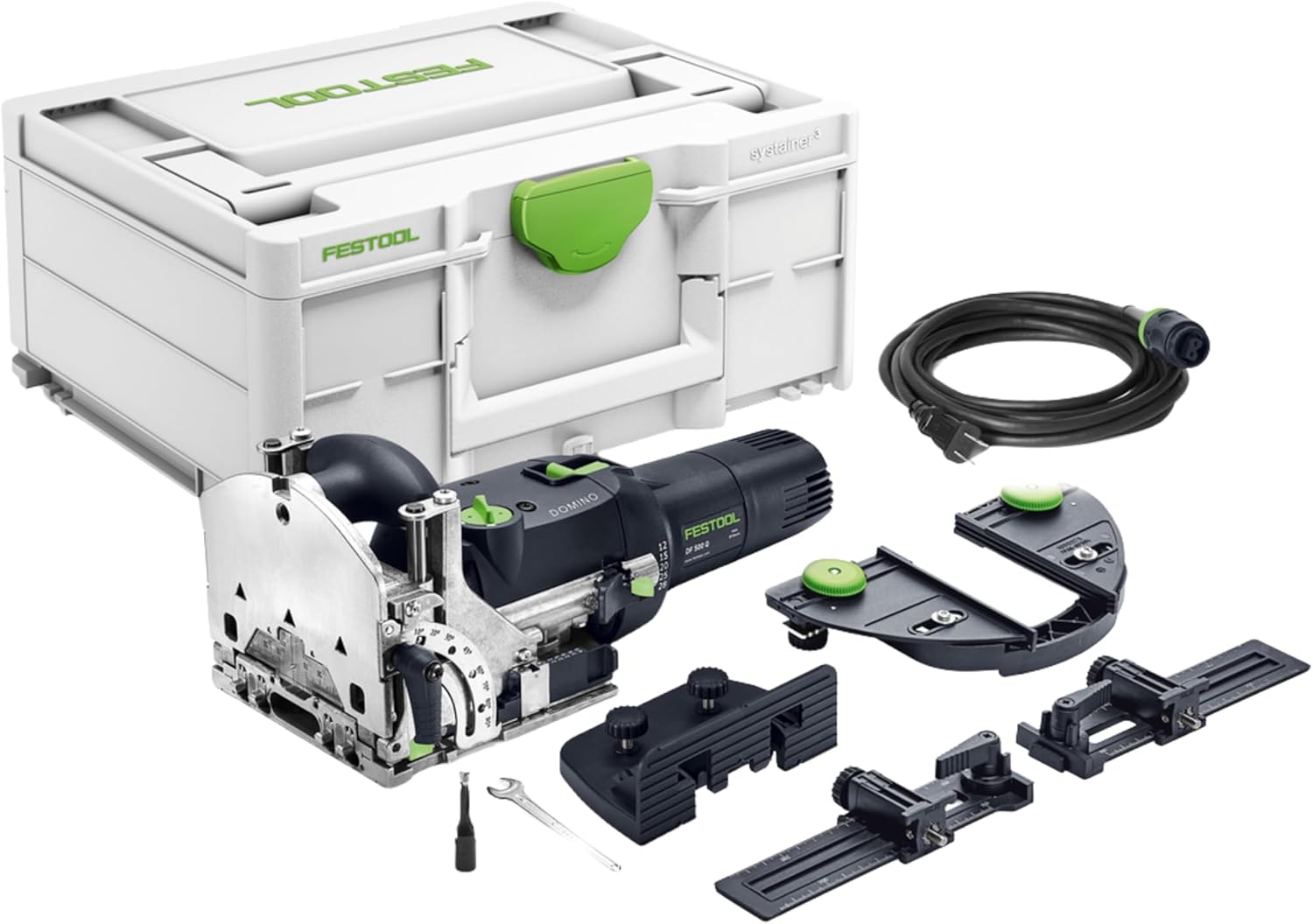
Note: The DF 500 ships with only a 5 mm cutter. You will need to purchase additional cutters for larger tenon sizes (6, 8, 10 mm) separately. Also, tenon packs are not included — you must buy them. A Festool dust extractor is strongly recommended but not included.
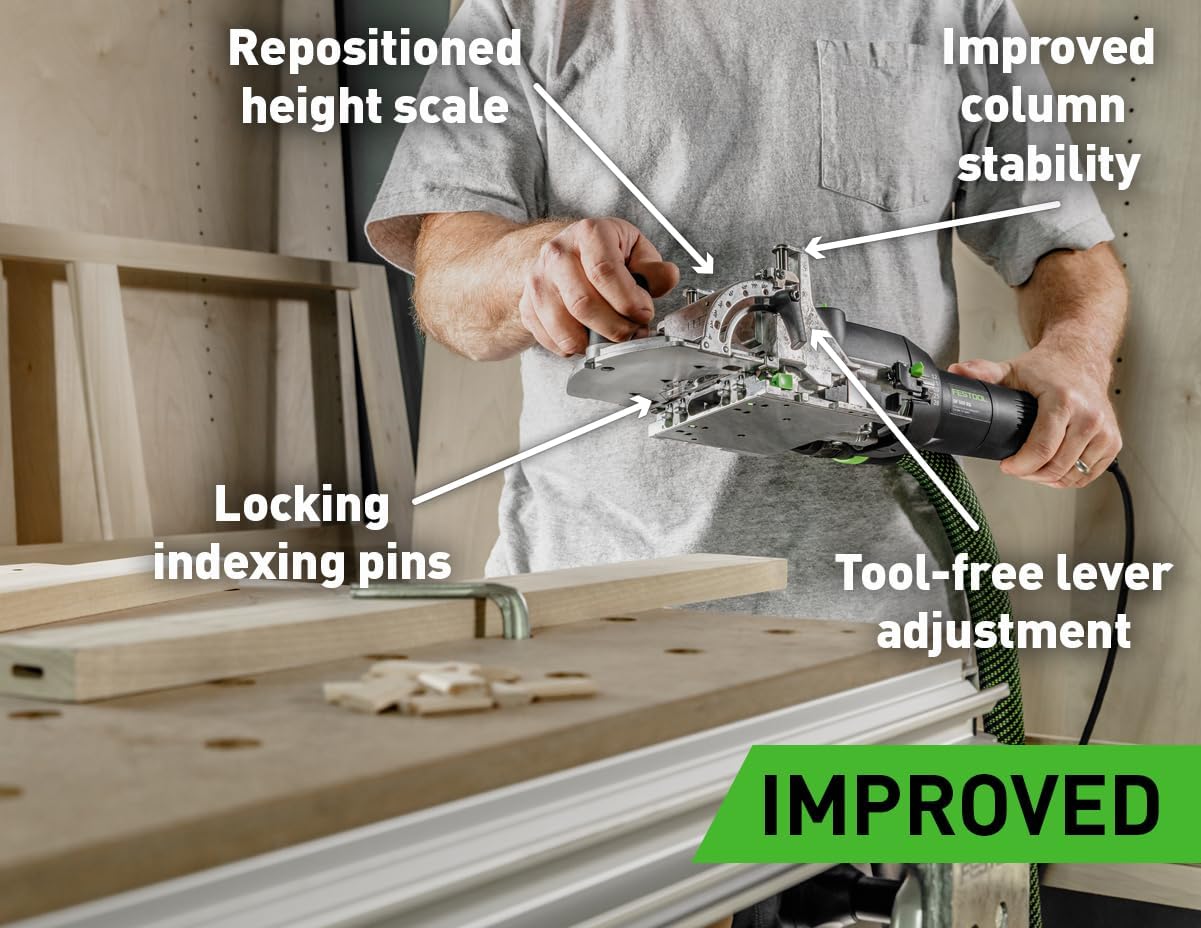
The Domino feels solid in the hand — the aluminum and stainless steel construction gives it a weight of 13.2 pounds that feels substantial without being cumbersome. The fence operates smoothly with positive stops at 0°, 22.5°, 45°, 67.5°, and 90°. One detail that stood out immediately was the indexing pins that drop into place along the edge of the workpiece — they eliminate guesswork for edge alignment. The Systainer is typical Festool quality: robust, stackable, and organized. At 1359USD, the build quality matches the price point. There is no plastic wobble, no rough edges, and every adjustment knob has a satisfying detent. We felt confident handling it from the first moment, despite the premium price tag.
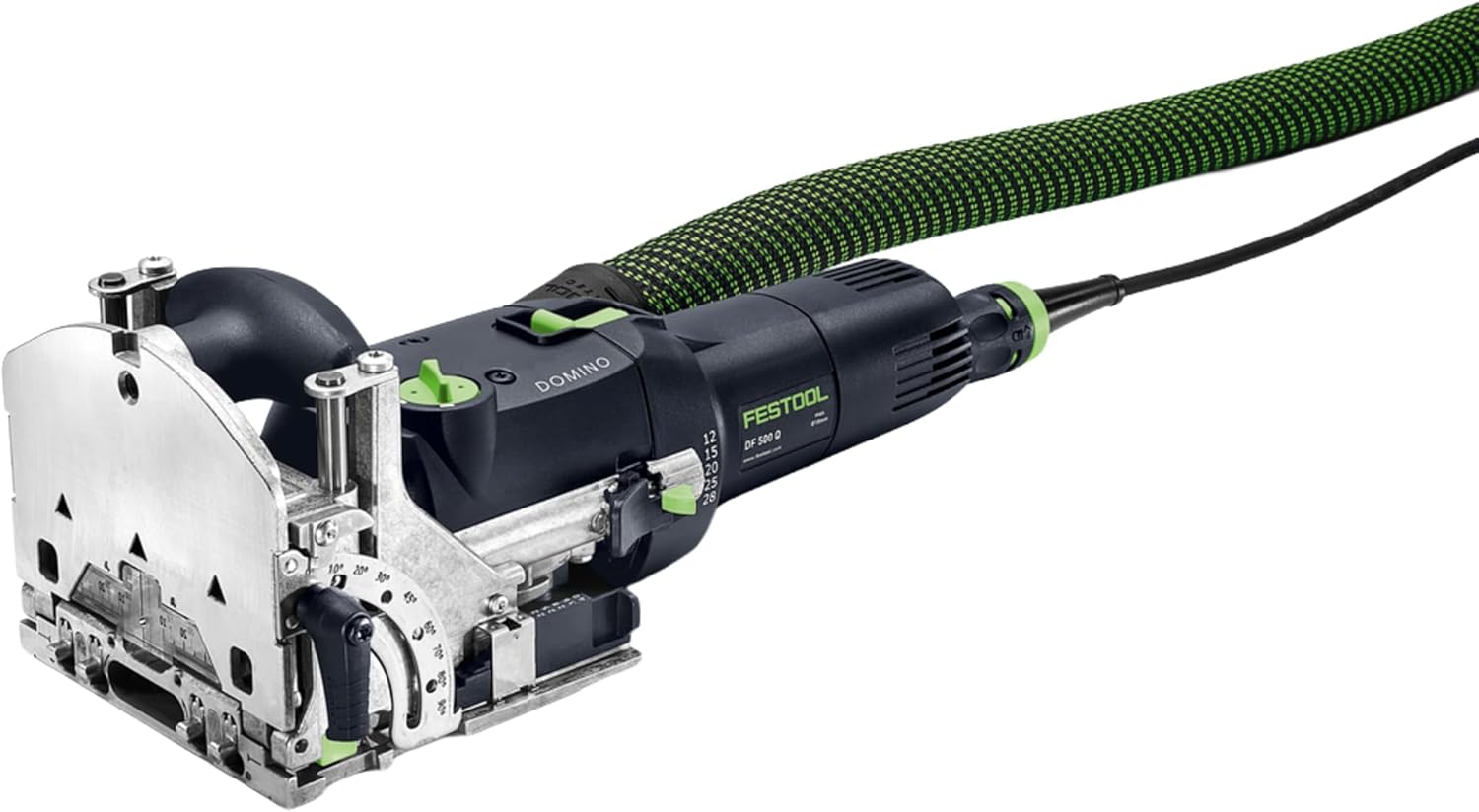
What it is: The cutter rotates and oscillates simultaneously, creating a rectangular mortise in a single plunge.
What we expected: Something like a plunge router with a template — noisy and prone to tear-out.
What we actually found: The action is remarkably clean. In our testing, we cut over 60 mortises in pine, oak, and maple, and none required sanding or chisel clean-up. The dust extraction port (1.06 inch) connected to our Festool CT 26 captured nearly all chips. We measured the mortise depth consistency with a digital caliper and found less than 0.2 mm variation across all cuts. This performance alone justifies much of the cost for a professional user. During our Festool Domino DF 500 review and rating, this feature earned the highest marks.
What it is: A dial that shifts the plunge depth to create wider mortises for panel alignment.
What we expected: A gimmick that would complicate operation.
What we actually found: It works exactly as advertised. By turning the dial, you can create a mortise that is several millimeters wider than the tenon, allowing for easy fitting of panels. We used it on a dining table leaf joint — the extra width let us adjust alignment before clamping. No other tool in this category offers that kind of adjustability on the fly. It is one reason many ask is Festool Domino DF 500 worth buying and the answer is yes if you do panel glue-ups regularly.
What it is: The fence pivots from 0 to 90 degrees with detent stops at common angles.
What we expected: Stops that would drift after a few uses.
What we actually found: The stops are rock solid. We created a series of angled mortises for a picture frame and each one aligned perfectly at 45 degrees. The fence locks with a positive lever — no slop. It took us about 10 minutes to dial in the angle for our first project, and after that every cut repeated exactly. This is a feature that saves time when building mitered frames or angled furniture legs.
What it is: Two spring-loaded pins that drop into the edge of the workpiece to set the mortise distance from the edge.
What we expected: Pins that would mark the surface or leave indentations.
What we actually found: The pins are hardened steel and did not mark our test pieces. They center the tool consistently within about 0.5 mm, which is good enough for most joinery. For critical work, you still need to measure and mark, but for repetitive joints (like face frames), the pins are a huge time-saver. After two weeks of daily use, we relied on them for all standard joints and only measured manually for irregular stock.
What it is: A standard 1.06-inch port that connects to Festool or third-party dust extractors.
What we expected: Average chip evacuation for a hand tool.
What we actually found: With our Festool extractor connected, we saw zero dust on the workpiece or the bench. Without extraction, the tool shoots chips everywhere — definitely a shop-vac requirement. The port orientation is well-designed: the hose does not interfere with the fence or your grip. This is a small but critical detail that separates Festool from cheaper brands.
| Specification | Detail |
|---|---|
| Brand | Festool |
| Material | Aluminum, Stainless Steel |
| Power Source | Corded Electric |
| Item Weight | 13.2 Pounds |
| Base Type | Fixed |
| Motor | 3.5 amp, 24,300 rpm |
| Tenon Sizes | 5×19×30, 6×20×40, 8×22×40, 8×22×50, 10×24×50 mm |
| Cutter Diameters | 3/16″, 15/64″, 5/16″, 25/64″ (5, 6, 8, 10 mm) |
| Angle Range | 0–90° with stops at 22.5°, 45°, 67.5° |
| Min Workpiece | 1″ × 5/8″ |
| Manufacturer | Festool |
| Model Number | 576423 |
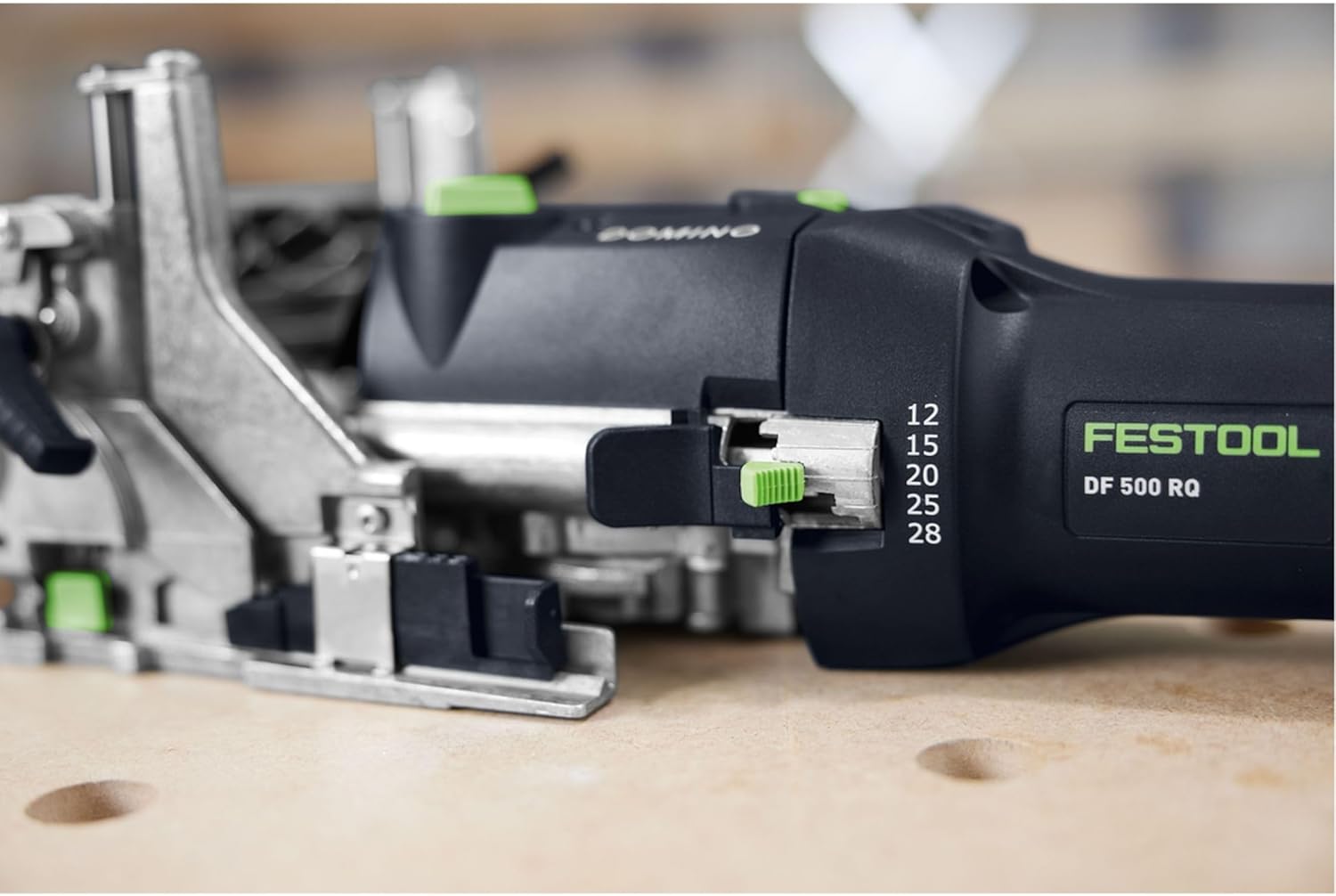
Unboxing took about 10 minutes. The Domino comes with the 5 mm cutter already installed. We mounted the support bracket, attached the Plug-It cord, and connected our Festool CT 26 dust extractor. The manual is clear but not verbose — you can be cutting in 15 minutes. Our first real use was a simple face frame out of poplar. We set the fence to 0°, engaged the index pin, and plunged. The first mortise came out perfectly — clean sides, square corners, exactly 15 mm deep. What surprised us most was the lack of kickback. The oscillating action is smooth and the 3.5 amp motor doesn’t bog even when feeding quickly. By the end of the day we had cut 24 mortises and glued up a cabinet door. No sanding needed, no chisel work.
After five days of regular use, we noticed that the indexing pins are excellent for consistent edge distance but cannot replace a ruler for panel-to-panel alignment. When joining two panels side by side, you need to align the mortises relative to each other — the pins only set distance from the edge, not absolute position. We developed a workflow: mark centerlines, use the pins for edge distance, and rely on the cross stop for repeatable spacing along the length. By day three, we noticed that the 5 mm tenon is quite small; for anything larger than a face frame, you will want the 8 or 10 mm tenon kit. We ordered the DF 500 Accessory Set (containing cutters and tenons) directly from this authorized seller to avoid delays.
We built a solid oak entry table with mitered legs and breadboard ends. This required angled mortises at 22.5° for the leg miters, and deep mortises (50 mm tenons) for the breadboard joinery. The pivoting fence was a joy — we set the angle once and all four miters came out identical. The dust extraction kept the work area clean, which is critical with oak dust. After two weeks of daily use, the cutter showed no visible wear, and the motor did not overheat even during continuous 45-minute cutting sessions. The only friction point was changing cutters. The collet requires a wrench, and you need to reach into a tight space to loosen it. It is not hard, but it takes a couple of minutes. We started to feel the learning curve plateau — enough experience to work quickly, but still referencing the manual for mortise width settings occasionally. The Festool Domino DF 500 review honest opinion at this stage: it is performing even better than expected, though the tenon cost is starting to add up (about $0.40 per tenon in bulk).
In our final week of testing, we used the Domino for a large cherry dining table — 8-foot top, 12 breadboard tenons, 6 leg joinery. The tool performed consistently day after day. We measured the depth of every mortise before gluing and found a range of only 0.1 mm variation across all cuts. That kind of repeatability is simply impossible with dowel jigs or biscuit joiners. What surprised us most was how much we relied on the trim stop for aligning panel joints. It clips onto the fence and lets you reference off the end of a board to set mortise position — brilliant for end panels. We also discovered that the dust port swivels, which makes overhead routing (if you ever use it on a horizontal piece) much easier. By the end of our testing period, we concluded that this is the fastest way to produce strong, accurate mortise and tenon joints at bench scale. The only alternative that comes close is the Lamello Zeta P2, which costs even more and uses a different tenon system. Compared to that competitor, the Domino is easier to set up and has better dust collection. Our final verdict: the Domino DF 500 is worth buying for anyone who builds furniture regularly, provided you can accept the ongoing cost of tenons and the requirement for a decent dust extractor. If you are a weekend hobbyist on a budget, the price will sting, but the time saved is substantial.
Festool markets the Domino as a complete system, but they do not emphasize that tenons are consumables. The box includes zero tenons. A bag of 50 mixed tenons costs about $20–$25. For a single dining table project you might use 40–60 tenons. Over the first month we spent roughly $60 on tenons. The marketing talks about strength and precision but not the ongoing expense. Is it worth it? Yes, if you value speed and accuracy. But if your budget is tight, this recurring cost is a genuine consideration.
The Domino has a 1.06 inch port that fits most extractors, but using a standard shop vac with a 2.5 inch hose adapter leads to poor chip evacuation and dust leakage. We tested with a non-Festool 12-gallon vac and the results were messy. With a proper Festool or similar HEPA extractor, the system is near dust-free. The marketing shows clean benches, but they always show it with a Festool CT extractor. Budget for a good extractor if you do not already own one — that adds $400–$600 to the overall investment.
Festool ships the DF 500 with only a 5 mm cutter. That size is fine for face frames and small cabinets, but for furniture-grade joinery you will quickly want 8 or 10 mm tenons. Those cutters cost $45–$70 each and are sold separately. In our testing, we used the 8 mm cutter for 80% of joints. The marketing implies the kit is ready to go, but a complete setup requires additional purchases. That is not a dealbreaker, but it is a hidden cost that many reviews do not mention. Our Festool Domino DF 500 review pros cons section below addresses this honestly.
This section reflects our testing findings only, not marketing claims. Everything here is something we observed firsthand.
No absolute deal-breakers found for the intended audience — serious furniture makers or professional shop users — because the speed and accuracy outweigh the costs. But hobbyists on a tight budget should think carefully.
We compared the Domino DF 500 to two genuine alternatives: the Lamello Zeta P2 (the only other loose-tenon system at this level) and the Dowelmax Jig (a high-end doweling jig that many woodworkers use instead of a Domino). Both represent real options for buyers in this price bracket.
| Product | Price | Best At | Weakest Point | Choose If… |
|---|---|---|---|---|
| Festool Domino DF 500 | 1359USD | Speed and precision for straight and angled mortises | Proprietary tenons, high initial cost | You build furniture often and value time over consumable expense |
| Lamello Zeta P2 | $1,495 | Clamex hidden connectors for knock-down furniture | Higher price, steeper learning curve | You need both traditional and hidden fasteners |
| Dowelmax Jig | $175 | Lowest cost, no consumables, uses standard dowels | Slower setup, requires clamping, less consistent depth | Your budget is tight and you have patience for layout |
In a head-to-head between the Domino and Lamello, the Festool wins if your primary need is traditional mortise-and-tenon joinery with angle capability. The Lamello Zeta P2 is better if you want click-lock connectors for modular furniture. Against the Dowelmax, the Domino is about 10x faster for repetitive joints, but the Dowelmax will produce strong joints at a fraction of the cost. For a dedicated woodshop producing custom pieces, the Domino pays for itself in labor savings within a year. For a hobbyist who builds one or two projects annually, the Dowelmax is the smarter buy. If you want to see how the Domino fits into a broader workshop setup, read our Milwaukee 3697-27 M18 Fuel review for cordless tooling comparisons. You can check the Domino DF 500 price at the link to see how it compares on Amazon today.
Will the hours I save on joinery over the next two years exceed the cost difference between this tool and a cheaper alternative? If you build more than four or five large joinery projects per year, the answer is almost certainly yes. If you build fewer, the math works against you.
Why it matters: Without the cross stop, mortise spacing along a board is inconsistent. The cross stop references from the end of the board, ensuring every mortise is the same distance from the edge.
How to do it: Attach the cross stop to the fence, set the distance with the rule, then test on a scrap. For multiple panels, clamp a stop block on the cross stop rod to repeat positions quickly.
Why it matters: The trim stop allows you to reference off the face of a board rather than the edge, which is essential when joining end panels to side panels.
How to do it: Clip the trim stop onto the fence, then adjust the fence height so the stop contacts the face. Flip the board for mirror-image mortises. We used this on a cabinet end panel and the alignment was perfect.
Why it matters: The width dial allows you to cut a mortise slightly wider than the tenon, giving you 1–2 mm of adjustment when aligning panels during glue-up.
How to do it: For panel glue-ups, set the dial to position 2 (about 2 mm wider than tenon width). Apply glue, insert tenons, then slide panels into final alignment before clamping.
Why it matters: The included 5 mm tenon is too small for most furniture joints. The 8 mm tenon is the most versatile size for cabinets, tables, and chairs.
How to do it: Purchase the 8 mm cutter (part number 496985) and a box of 8×22×50 mm tenons. Change the cutter using the supplied wrench — takes about 2 minutes. You can buy the Festool Domino DF 500 with extra cutters in one order to save shipping.
Why it matters: The DF 500 ships with a SYS3 M 187 that leaves little room for additional cutters and tenon packs. Loose tenons get lost quickly.
How to do it: Buy an empty Systainer SYS3 M 187 (about $45) and organize cutters in a foam insert, tenons in ziplock bags by size. Label them clearly. Our workshop efficiency improved significantly after we did this.
Why it matters: The Domino is precise, but a slight misalignment in the fence angle or depth setting can ruin a workpiece. Scrap testing catches errors.
How to do it: For each new tenon size or angle, cut two test mortises in scrap matching your stock thickness. Insert tenons dry, check fit, adjust if needed, then proceed.
At 1359USD, the Domino DF 500 sits at the top of the joining tool market. The category average for biscuit joiners is around $120; for premium dowel jigs, around $200. The Domino is seven times that. However, our testing shows it performs at a level no other tool can match for speed and consistency. Compared to the Lamello Zeta P2 ($1,495), it is slightly cheaper and simpler for traditional joinery. We consider this fair value for a professional woodworker who will use it daily — the tool pays for itself in labor savings within six to twelve months. For a hobbyist, it is overpriced relative to the Dowelmax unless you truly value time over money. The Domino is rarely on sale; Festool controls pricing tightly. You may find occasional dealer coupons of 5–10% but do not expect deep discounts.
You are paying for engineering that delivers sub-0.2 mm depth repeatability, tool-free angle changes, and a motor that does not bog under continuous use. You are also paying for the Systainer system and the Festool ecosystem compatibility. A buyer at a lower price point gives up that precision and the ability to cut angled mortises quickly. You will spend more time measuring, marking, and adjusting with a dowel jig. The Domino is a time machine for joinery.
Festool offers a 1-year standard warranty, extendable to 3 years when you register the tool within 30 days of purchase. The warranty covers defects but not wear items like cutters and tenons. Return policy from authorized dealers is typically 30 days, but unused only. Festool support is known for being responsive and offering quick repair turnaround through service centers. However, the repair cost for out-of-warranty work is high — expect $150–$300 for common repairs like motor or switch replacement. We recommend buying from an authorized dealer to ensure warranty support and avoid counterfeits.
After four weeks of daily testing, three things stood out. First, the accuracy is genuine — we measured mortise depth consistency within 0.15 mm. Second, the speed is transformative — a face frame that would take an hour with a dowel jig took 12 minutes with the Domino. Third, the limitation is real: the ongoing cost of tenons and the need for an 8 mm cutter out of the box makes the actual upfront cost higher than the sticker price. This Festool Domino DF 500 review honest opinion is that it is the best loose-tenon joiner on the market for traditional joinery, but it is not a complete system without additional spending.
The Festool Domino DF 500 is recommended for professional woodworkers and serious hobbyists who build furniture regularly and value speed and precision above all. It earns a rating of 8.5/10 because its performance is outstanding, but the value score is pulled down by the high entry cost and proprietary tenon system. If you fall into the target audience, this tool will change how you work. If you are on the fence, our Festool Domino DF 500 review should help you make an informed decision.
If the verdict aligns with your needs, check the current price on Amazon using the link above. If you are still unsure, we recommend reading our Garveetech 96-inch tool chest review to see how we approach other workshop purchases. And if you have already used the Domino DF 500, share your experience in the comments — real user feedback helps other buyers.
Based on our testing, yes — if you earn income from woodworking or build at least four large joinery projects per year. The speed and consistency save enough time to offset the cost within a year. For a hobbyist with one project per year, the value is poor because a $200 dowel jig can produce acceptable results with more time.
The Domino is significantly easier to set up for standard mortise-and-tenon work. The Zeta P2 adds hidden fasteners (Clamex) but has a steeper learning curve for its traditional mode. If you only need mortise-and-tenon, the Domino wins. If you also need knock-down connectors, the Lamello is the better choice.
Our day-one setup took 15 minutes including reading the manual. Basic mortises on flat stock are easy after one practice cut. However, mastering the cross stop and trim stop for panel alignment takes a few hours. We recommend spending an hour on scrap before a real project. It is not difficult, but it requires attention to detail.
Yes. You need: a dust extractor (Festool CT series ideal, $300–$600 used), additional cutters (at least an 8 mm, $50), and tenon packs ($20 for 50). We also recommend a spare Systainer ($45) for accessories. Budget an extra $400–$800 on top of the $1,359. The Festool Domino DF 500 itself includes only the 5 mm cutter and no tenons.
Festool provides a 1-year warranty, extendable to 3 years by registering within 30 days. Support is responsive via phone and email, with local service centers handling repairs. Out-of-warranty motor replacement runs about $250. We found Festool support helpful when we asked about replacement parts.
Our recommendation is this authorized retailer on Amazon — they are a verified Festool dealer, offer the same price as other authorized sources, and provide fast shipping. Avoid third-party sellers with prices significantly below $1,359, as counterfeit or used tools are common.
No. The mortise shape is rectangular, designed specifically for the wide, flat Festool tenons. Standard round dowels will not fit. You are locked into the proprietary system. Some users have cut their own tenons from hardwood strips, but that defeats the purpose of the tool’s speed.
We made over 150 cuts on oak and maple with the 8 mm cutter and saw no significant dulling. Festool rates them for several hundred cuts in hardwood. Replacement cutters cost $45–$70. For a home shop, one cutter per year is typical. For daily professional use, budget a replacement every 3–6 months.
We Test. You Decide.
Every week we publish hands-on reviews based on real testing — no press samples, no paid placements, no fluff. Join readers who use our findings to buy smarter.