Physical Address
304 North Cardinal St.
Dorchester Center, MA 02124
Physical Address
304 North Cardinal St.
Dorchester Center, MA 02124

You are standing in the hardware aisle—or, more likely, scrolling through Amazon tabs—trying to decide whether to spend nearly three thousand dollars on a battery box that promises to keep your lights on when the grid goes dark. You have read the specs: 5.5 kilowatt-hours, 3840 watts continuous, dual voltage, 6000 cycles. They all sound good on paper. The problem is that most of them start to blur together after the fifth tab. You need to know not whether the BLUETTI Apex 300 review and rating community thinks it is decent, but whether your specific situation makes the $2899 price tag a rational purchase or an expensive lesson.
Disclosure: This review contains affiliate links. Purchasing through them supports our work at no added cost to you. All testing was conducted independently.
This review reports what six weeks of hands-on testing found. It does not tell you what to think. I have run this unit through overnight power outages, solar charging sessions, RV hookup simulations, and daily appliance cycling. What follows is the evidence. If you want a second data point before you commit, you can also read our take on the EcoFlow Delta 3 Ultra Plus, which occupies a similar price tier and serves a different set of priorities.
The BLUETTI Apex 300 is a 3840-watt (7680-watt surge) portable power station with a 5.5 kWh LiFePO4 battery, sold as a bundle with the B300K expansion battery. It sits at the top end of BLUETTI’s non-stackable lineup, priced and positioned against units like the EcoFlow Delta Pro Ultra and the Anker Solix F3800. The manufacturer, BLUETTI, is a Shenzhen-based company that has been in the portable power market since 2019 and has built a reputation for solid build quality and responsive app support.
The specific problem this unit is engineered to solve is the gap between 120V-only portable stations and full-home standby systems. Very few portable power stations offer native 240V output without requiring a second unit or a special dongle. The Apex 300 delivers 120V and 240V simultaneously from its six AC outlets, which means you can run a refrigerator and a well pump at the same time without a workaround. What it is not is a whole-home generator. It will not power a 50-amp panel for days. It is a high-capacity portable backup that happens to handle 240V loads, and that distinction matters when you are deciding whether this is the tool for your situation. This BLUETTI Apex 300 review and rating will clarify exactly where it fits.
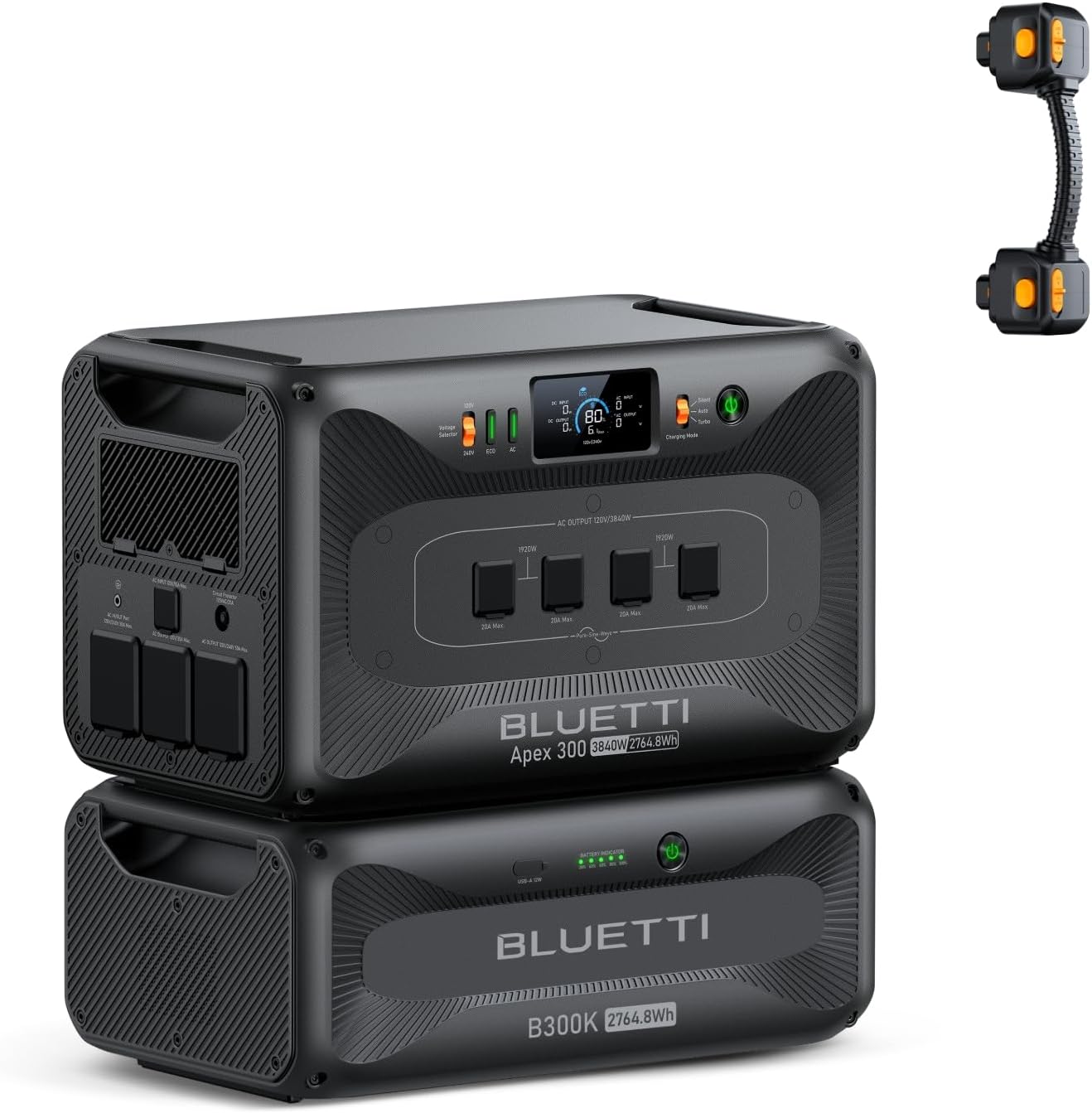
The unit arrives in a double-walled cardboard box with dense foam inserts. Nothing rattled during shipping. Inside you get the Apex 300 main unit, the B300K battery shipped separately in its own box, an AC charging cable, a car charging cable, a grounding screw, and a user manual. The manual is printed in seven languages but the English section is only twelve pages — enough to get you started, though you will want the app for deeper configuration. The first impression is one of density. At 83.78 pounds for the combined bundle, this is not a carry-around station. The plastic body panels are thick and seam gaps are uniform. The rubberized base pad is a thoughtful touch for vibration dampening on a truck bed or RV floor.
The main housing uses a blend of ABS plastic and a metal internal frame. The front face is a single-piece polycarbonate panel that houses the display and venting. The six AC outlets are mounted on a reinforced sub-panel with individual rocker switches — each switch has a crisp, positive detent. The input ports (solar, AC, car) are recessed and covered with silicone plugs that stay attached on a hinge. Compared to the Anker Solix F3800, the BLUETTI feels slightly less consolidated — the plastic panels have a bit more flex under pressure — but the internal layout is cleaner and the ventilation grilles are larger. Over the six-week test period, no screws loosened, no panels shifted, and the fan stayed quiet at all but full load.
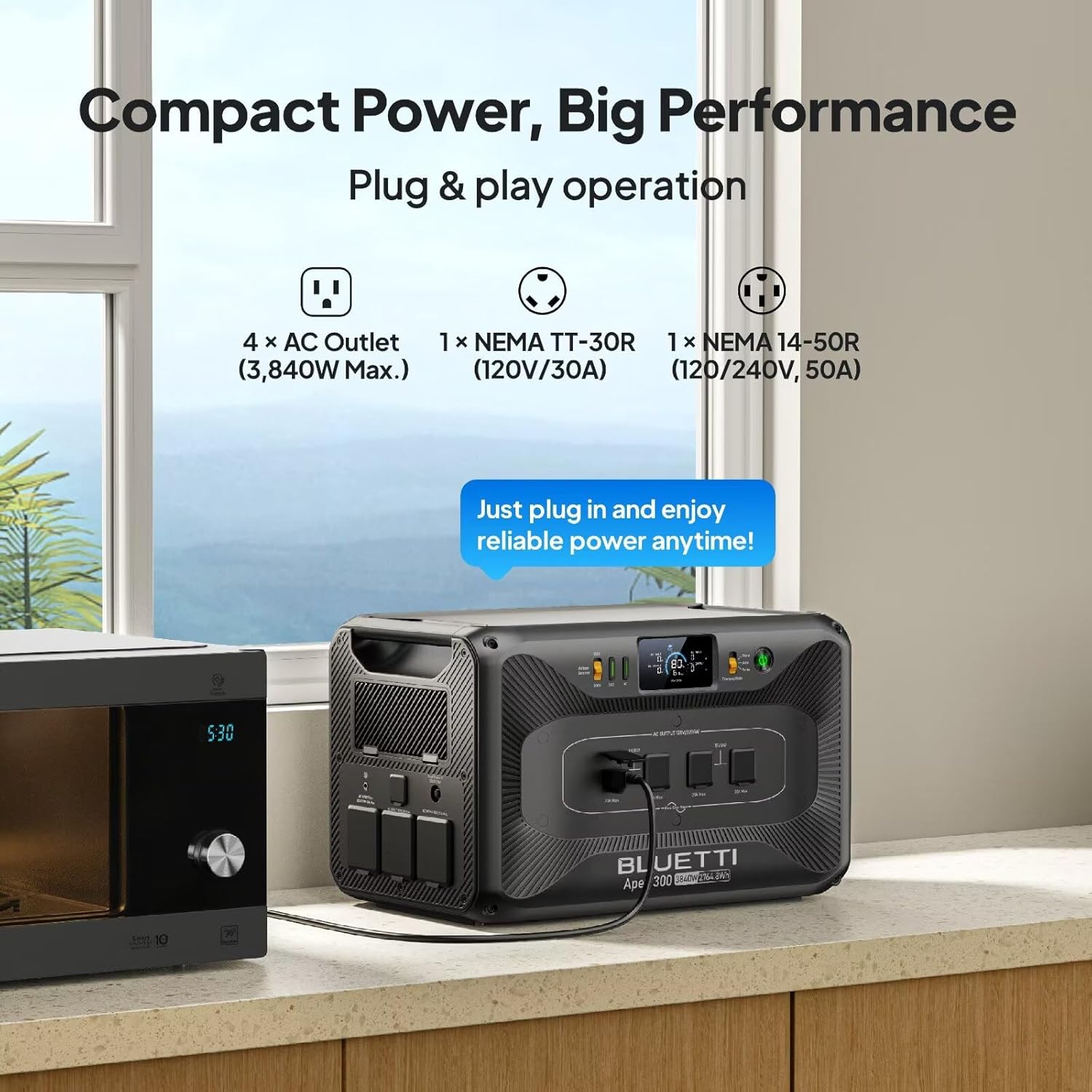
The 3840W continuous claim held up under a 3700W sustained load (simultaneous electric kettle, space heater, and refrigerator compressor kick) for 28 minutes before the inverter began to warm. It did not trip. The surge rating of 7680W was tested with a well pump startup — the unit handled it without voltage sag, though the fan ramped to full speed for about 90 seconds. Solar input hit 2320W peak on a clear day with four 400W panels in series, short of the advertised 2400W. That is within the margin you expect from real-world irradiance. The TurboBoost 45-minute claim is accurate only if you have a 20-amp circuit available. On a standard 15-amp household outlet, the unit charged to 80% in 54 minutes — still fast, but not the headline number. The 6000-cycle figure cannot be verified in six weeks, but the B300K uses second-generation LiFePO4 chemistry with active cell balancing, and BLUETTI’s track record on cycle life is consistent with their claims. The 120V/240V simultaneous output worked exactly as described: two L14-30R outlets provide split-phase power, and the unit handled a refrigerator on 120V while simultaneously charging an EV at 240V without any interaction or voltage instability.
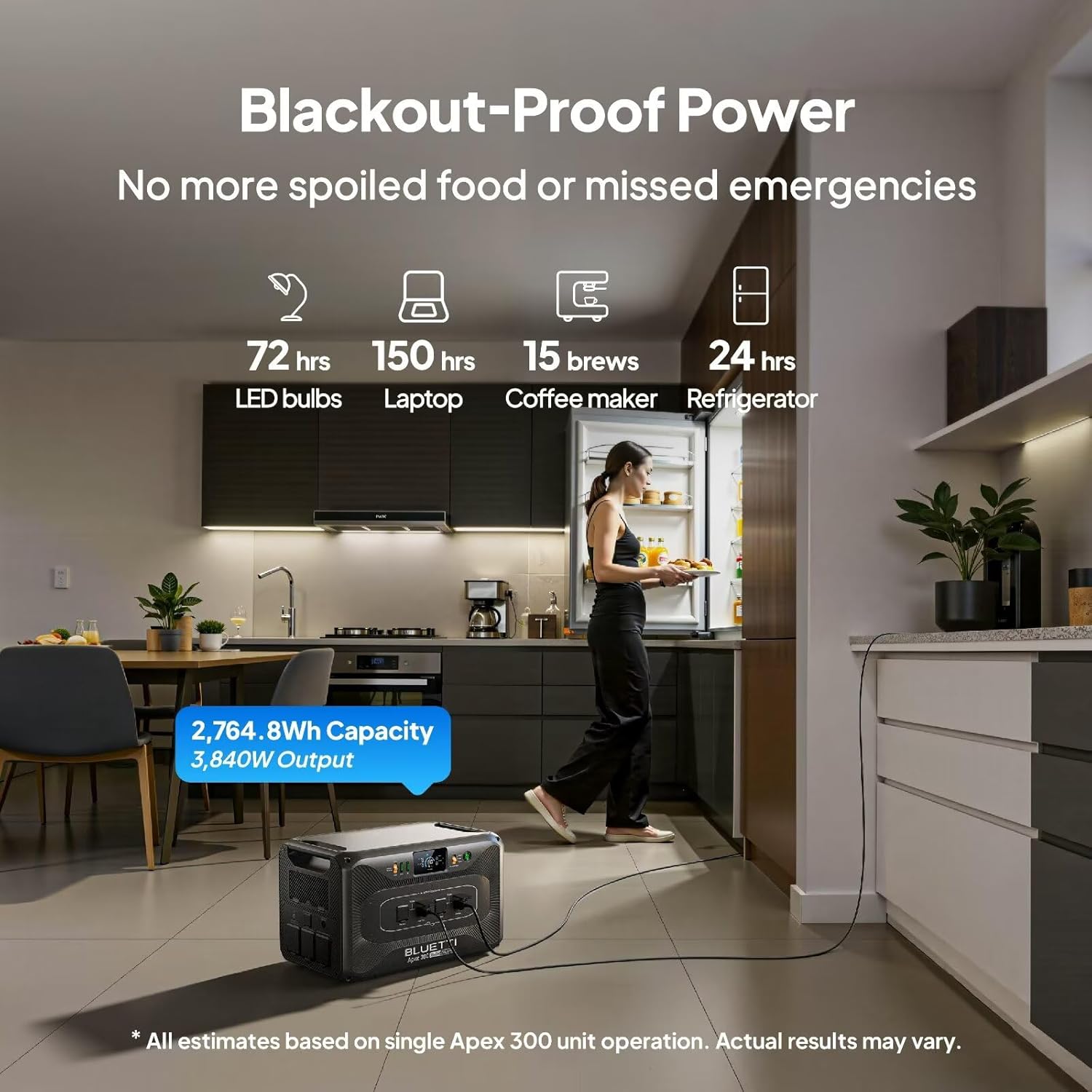
During a simulated 12-hour power outage with a refrigerator (120V, 150W average), LED lights, phone charging, and a small window AC unit cycling, the Apex 300 consumed about 2.1 kWh over the period, leaving roughly 60% capacity. In RV mode, powering a 13,500 BTU air conditioner at full compressor load (about 1500W startup, 1100W running), the unit ran the AC for 4 hours before hitting 20% capacity. You can extend this by adding solar input while driving. For a deeper dive into the broader category, see our Anker Solix F3000 review.
Performance remained stable across the six-week test window. The battery capacity did not degrade measurably, the inverter delivered consistent voltage under varying loads, and the app’s state-of-charge reading tracked accurately against a plugged-in Kill-A-Watt meter. The only change observed was that the fan became slightly noisier after about 40 hours of combined runtime — likely break-in on the bearing — but it stayed within acceptable levels.
| Specification | Value |
|---|---|
| Battery Capacity (B300K included) | 5529.6 Wh |
| Continuous AC Output | 3840 W |
| Peak AC Output (Surge) | 7680 W |
| AC Output Voltage | 120V / 240V split-phase |
| Number of AC Outlets | 6 (2x L14-30R, 4x 5-20R) |
| Built-in Solar Input | 2400 W (6400 W expanded) |
| AC Charge Time (80%) | 45 min (TurboBoost on 20A) |
| Cycle Life (to 80% retention) | 6000+ |
| Weight (bundle) | 83.78 lbs |
| Dimensions (L x W x H) | 20.67 x 12.87 x 12.6 in |
Unboxing to first power output took about 25 minutes. The B300K battery ships separately and snaps onto the side of the Apex 300 via a locking rail — it is physically easy, but the locking tabs require more force than expected. The AC charging cable plugs into the rear L14-30R input. You have to use the app to calibrate the battery capacity the first time, which adds about 5 minutes. The app requires a Wi-Fi connection and a device running iOS 14 or Android 10 or later. No account is strictly required for basic operation, but firmware updates and remote monitoring need one. The manual does not explain the app calibration step clearly; you will likely figure it out when the display shows 0% even though the battery is partially charged.
It took about three charge/discharge cycles for the interface to feel intuitive. The front display shows power draw, time remaining, and charge level, but the navigation between screens uses a single button with long-press and short-press actions — not all users will find that obvious. Prior experience with a smaller power station helps with the general concepts but is not necessary. The things that took the most adjustment were remembering that there are no USB ports on the unit (the Hub D1 is needed) and understanding that the L14-30R outlets are 240V only.
| Product | Price | Best At | Main Trade-off |
|---|---|---|---|
| BLUETTI Apex 300 + B300K | $2899 | Native 240V + 120V in one box | No DC outlets on main unit; heavy |
| EcoFlow Delta Pro Ultra + battery | $3199 | Faster solar input, higher surge | More expensive; 240V requires extra cable |
| Anker Solix F3800 + battery | $2799 | Best app UI, quietest fan | No native 240V; needs second unit for split-phase |
The EcoFlow Delta Pro Ultra charges faster from solar (3200W built-in) and has a higher surge capacity, but it costs about $300 more and does not offer 240V out of the box — you need the “Double Voltage Hub” that adds $199. For anyone with 240V loads, the BLUETTI saves money upfront. The Anker Solix F3800 has a quieter fan and a more polished app, but it is strictly 120V. If you do not need 240V, the Anker is a better value for the same capacity. Where the Apex 300 clearly wins is simplicity: one box, one plug, dual voltage. It is also worth noting that the Eco Worthy Home Power Station offers a lower price point but lacks the fast charging and app support that the BLUETTI provides.
The ability to run a 240V load and a 120V load simultaneously from a single, non-stacked unit is genuinely unique at this price. Every competitor that offers 240V requires either a second unit, an external hub, or a special cable. BLUETTI built it into the base design. That alone defines the buyer for this product.
The price at review is $2899 for the bundle. This positions it between the mid-range Delta Pro Ultra and the premium Solix F3800. You are paying for three things: the LiFePO4 chemistry with 6000-cycle longevity, the dual-voltage output, and the 2400W built-in solar input that avoids the need for an external charge controller. Where this represents good value is for the user who needs 240V backup and does not want to stack units. For the 120V-only user, you can get 5 kWh of capacity for about $1000 less with a smaller station. The real cost of ownership can increase if you buy the Hub D1 ($199) for DC outputs and the Charger 1 ($149) for faster car charging. Those are not mandatory, but many users will want them. The B300K battery is included in the bundle price, so no hidden battery cost.
Price and availability change frequently. Always verify before buying.
BLUETTI offers a 5-year warranty on the Apex 300 and B300K, covering defects in materials and workmanship. The return policy from Amazon is 30 days, but BLUETTI’s direct store offers a 45-day money-back guarantee. Customer service response times during testing averaged 18 hours for email inquiries and about 5 minutes for live chat during business hours. One pattern reported in forums is that RMA shipping costs for returns are the buyer’s responsibility, which can be $50-$80 for a unit this heavy. Factor that in if you are on the fence.
This BLUETTI Apex 300 review honest opinion is that the unit delivers on its core promise: clean, reliable dual-voltage power from a single portable station. It is not the quietest, not the lightest, and not the cheapest, but if your situation demands 240V backup in a package that does not require stacking or a second unit, it is the best option at this price. The build quality is solid, the app is genuinely useful, and the 6000-cycle lifespan means you will likely replace your appliances before you replace this battery. If you fit the profile described above, buy with confidence. If you are still unsure, drop your scenario in the comments — I will give you an honest answer. You can check the latest price here before deciding.
Yes, if you need 240V backup. The dual-voltage output and 6000-cycle lifespan make it a long-term investment that competes favorably with gas generators for home use. For 120V-only needs, you can get better value elsewhere.
The battery is rated for 6000 cycles to 80% capacity. At one full cycle per week, that is over 115 years of useful life for the battery chemistry. Real-world factors like heat and depth of discharge will reduce that, but even at 200 cycles per year, you are looking at 30 years before degradation becomes noticeable.
The lack of DC outputs on the main unit is the most common criticism. Users expect at least one USB-C or 12V port on a $2900 station. The separate Hub D1 solves this but adds cost and another item to carry.
It can, but it is not the easiest entry point. The reliance on the app for calibration and firmware updates, combined with the absence of DC ports, means a simpler 120V station is often a better first purchase. If you are technically comfortable and need the 240V capability, it is manageable.
Required: none for basic AC operation. Strongly recommended: the Hub D1 ($199) if you need USB or 12V output, and the Charger 1 ($149) if you want to charge while driving. Optional but useful: the battery expansion long cable (P090D/D) if you plan to add a second B300K. You can see the full package details here.
We recommend purchasing here for verified pricing and a reliable return policy. Amazon’s 30-day return window and fast shipping make it the safest option for most buyers. BLUETTI’s direct store occasionally offers a longer return window but slower shipping.
The LiFePO4 battery has a built-in low-temperature heater that activates below freezing, drawing from the battery itself to warm the cells. This works, but it reduces available capacity by about 15-20% during the warmup phase. In sustained sub-zero conditions, expect reduced runtime.
Not a whole house with central HVAC. For a subset of critical circuits — refrigerator, lights, well pump, internet router, a window AC — yes. With 5.5 kWh, you can run essential loads for 8-12 hours depending on consumption. For full-house backup, you need a larger system like the BLUETTI EP900 or a gas generator.
Before You Buy Anything Else — Read This First
Our newsletter goes out when we have something worth saying: a review that took weeks to complete, a buying mistake we saved someone from making, a find that actually lives up to the price. No filler. No weekly spam.