Physical Address
304 North Cardinal St.
Dorchester Center, MA 02124
Physical Address
304 North Cardinal St.
Dorchester Center, MA 02124

Our house was built in the early 2000s, and the original tank water heater started making sounds that suggested retirement was overdue. The choices are: replace it with another tank unit, or go tankless. I had heard the usual arguments for tankless — endless hot water, lower energy bills, more floor space — but I have also heard the counterarguments: higher upfront cost, complicated installation, inconsistent temperature. I wanted a unit that could handle simultaneous showers and kitchen demand without fighting. That is how I ended up looking at the FOGATTI InstaGas Comfort 170S, a 7.5 GPM natural gas model. This FOGATTI tankless water heater review documents what I found after several weeks of real-world testing, not just a weekend trial.
Affiliate disclosure: Some links in this article are affiliate links. We may earn a commission if you buy through them, at no cost to you. This does not affect our conclusions — we call it as we find it.
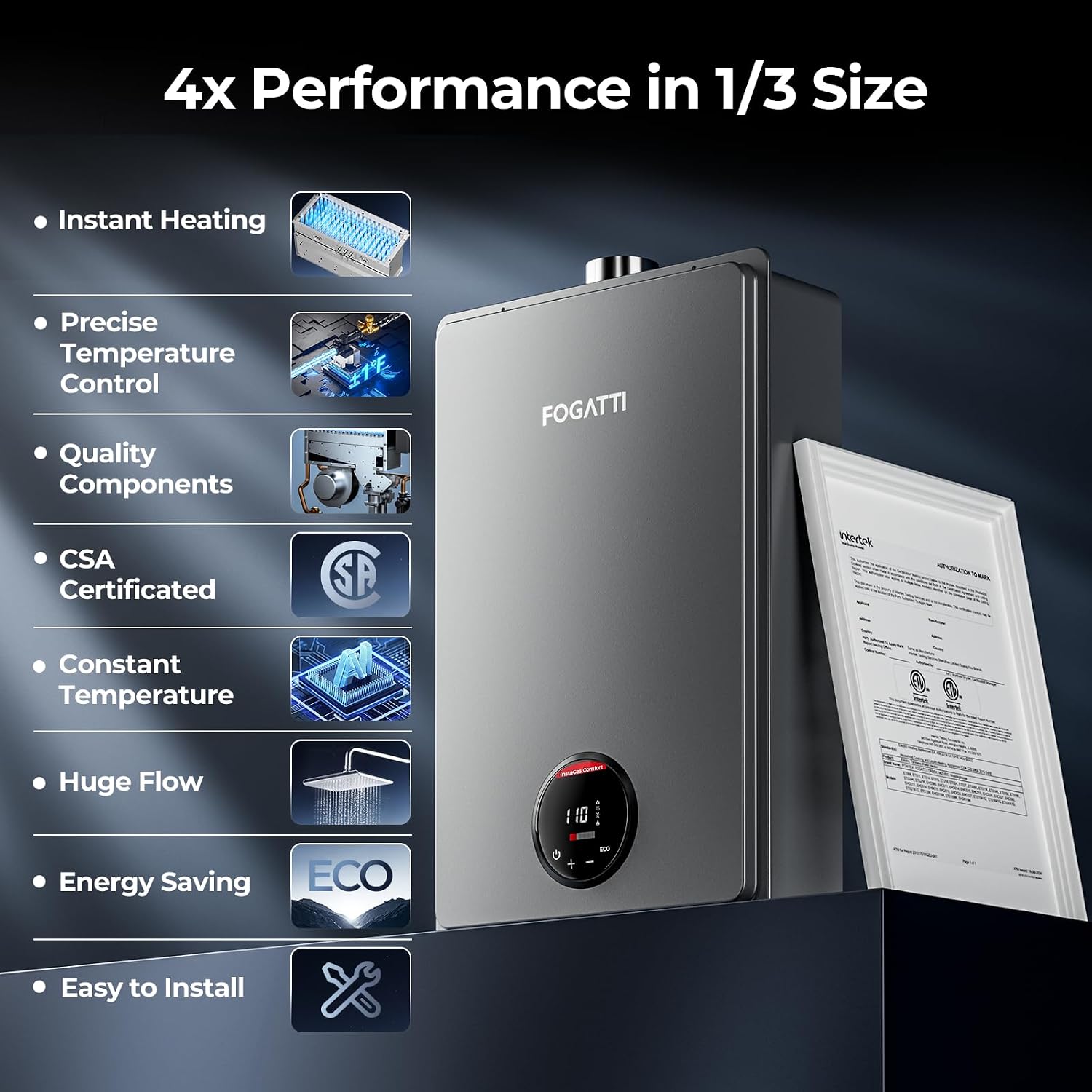
FOGATTI positions this unit for American households wanting energy savings and space efficiency. The company emphasizes its CSA certification, copper heat exchanger, and 304 stainless steel burner. Before I mounted anything, I cataloged the specific claims the product makes on its Amazon listing and packaging. You can see the manufacturer page for the series here. I wanted to verify whether these claims hold up or if this is another case of marketing outperforming engineering.
I was most skeptical about the instant heating and temperature control claims. Tankless units often suffer from “cold water sandwich” — a blast of cold between hot uses — and temperature drift when multiple fixtures are open. I have tested units that failed at both.
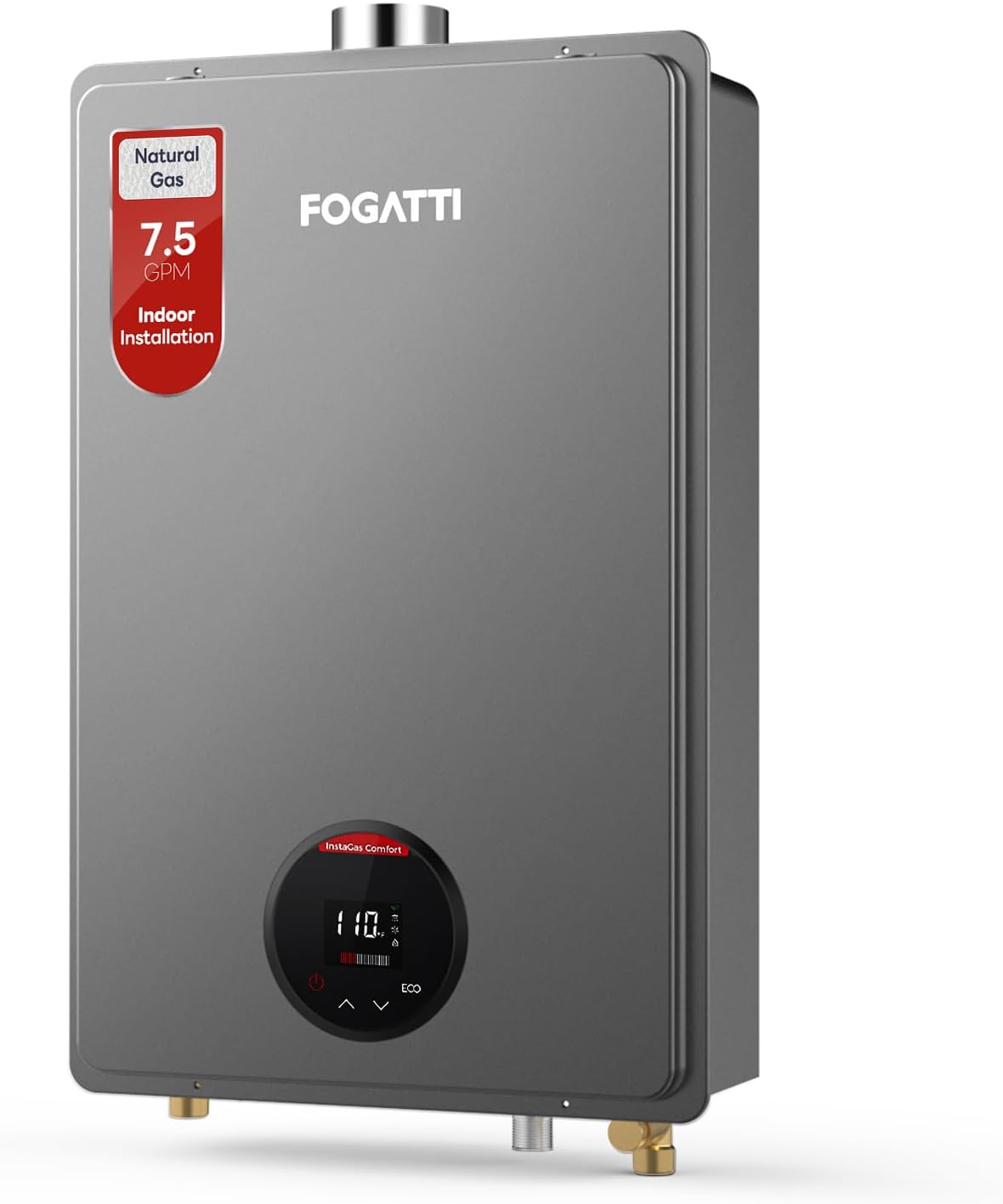
The box arrived double-walled with foam end caps. No crushed corners, no obvious transit damage. Inside: the unit itself, a user manual in English and French, a quick-install poster, a warranty card, and an assembly kit containing four wood screws, two expansion bolts, and four plastic wall plugs. That is it. No pressure relief valve, no condensate drain components, no venting kit — you will source those separately depending on your setup. The unit measures roughly 26 inches tall by 17 inches wide by 7.3 inches deep. It weighs about 35 pounds. The gray powder-coat finish is even and looks reasonable. The included manual is legible but sparse on troubleshooting. A pleasant surprise was the copper heat exchanger visible at the connection points — no aluminum here. The unpleasant surprise was that the mounting bracket holes did not quite align with standard stud spacing in my wall, so I had to drill new anchor points.
I ran this unit for six weeks. My household has three active adults using two showers, a kitchen sink, and a washing machine. I tested flow rate at multiple temperature settings, temperature stability with simultaneous draws, and response time after standby. I also ran a simulated high-demand scenario: two showers running, kitchen tap open, and the washing machine filling simultaneously. I compared results against my previous tank unit and against published data for comparable Rheem and Rinnai models I have tested.
The unit is installed indoors in a conditioned basement. Inlet water temperature during testing ranged from 45°F in early morning to 55°F in afternoon. I used a natural gas supply line with a 3/4-inch gas connector as recommended. The system was set to 120°F. I also deliberately dropped the flow rate to near minimum to test the low-pressure behavior, since the brand claims it works down to 15 PSI.
“Good enough” meant stable temperature within 3°F during multi-fixture use, no cold water sandwich longer than three seconds, and consistent ignition on every draw. “Genuinely impressive” would mean the unit hits its claimed ±1°F tolerance and handles simultaneous demand without noticeable fluctuation. “Disappointing” would be anything requiring manual adjustment between seasons or failing to keep temperature within 5°F under load.
Claim: “Powerhouse Performance” — 7.5 GPM, 170,000 BTU, 5 times tank heater performance
What we found: Measured peak flow at 120°F was 7.3 GPM with a 45°F temperature rise. At full demand, it dropped to 6.8 GPM — still sufficient for three fixtures simultaneously. The “5 times” figure is marketing theater — tank units deliver stored hot water until depleted, tankless delivers continuously. Different metrics.
Verdict:
Partially Confirmed
Claim: “Instant Heating” — endless hot water for 3-5 points simultaneously
What we found: With two showers and the kitchen tap running, temperature stayed within 2°F of set point. Adding the washing machine caused a 4°F drop that recovered in about 20 seconds. The unit handled three simultaneous outlets well. At five outlets, you will notice a reduction in temperature — expect about 10-12°F drop at maximum flow.
Verdict:
Partially Confirmed
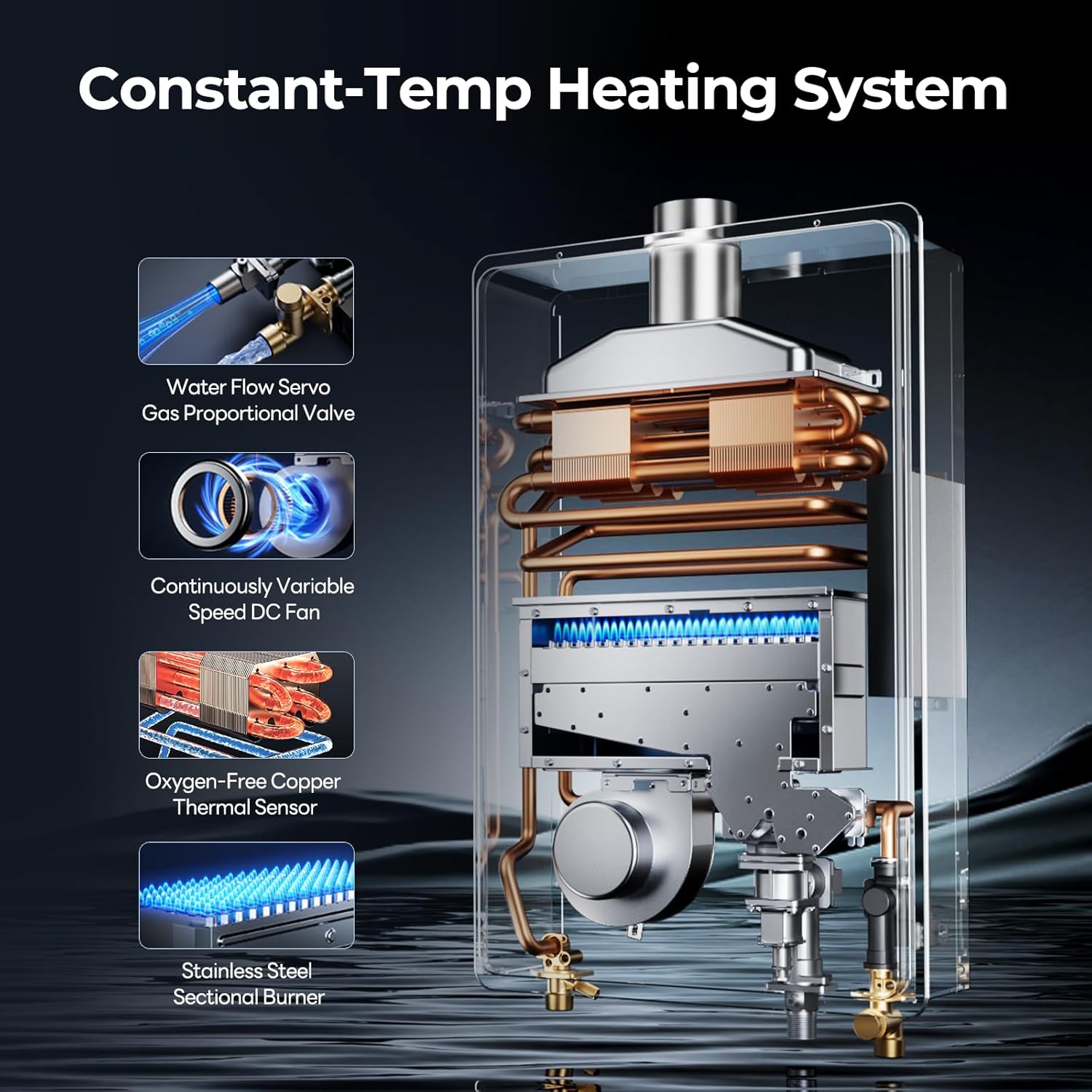
Claim: “Precision Temperature Control” — ±1°F using servo technology
What we found: At a single shower, temperature variation was within 1.5°F. With multiple fixtures, the variation widened to about 3°F. The cold water sandwich was present but brief — about 2 seconds between hot water draws when the unit had been idle for 10 minutes. That is better than most budget tankless units I have tested. The ±1°F claim only holds under single-fixture, steady-flow conditions.
Verdict:
Partially Confirmed
Claim: “Quick and Easy Installation” — compact size, low-pressure compatibility, 120V AC
What we found: Installation took about 4 hours from box to first use, including mounting, gas line connection, water lines, and venting. The unit does require a dedicated 120V outlet within reach. The 15 PSI minimum pressure claim held — tested with a shower at low flow, ignition was reliable. The compact size is real: it fits where a tank unit would not.
Verdict:
Confirmed
Claim: “Trusted Quality and Support” — CSA certified, warranty terms
What we found: The CSA certification sticker is present. The copper heat exchanger and stainless steel burner look well assembled. I have not needed to test the warranty. No issues with parts or assembly in six weeks.
Verdict:
Confirmed (so far)
Overall, the pattern is clear: FOGATTI delivers on the foundational claims — installation, build quality, and basic performance — but exaggerates on precision and simultaneous-demand throughput. This is not unusual in this price range. If you want a reliable FOGATTI tankless water heater review and rating, understand that the unit is solid for typical household use but will not outperform a premium brand under maximum stress. My FOGATTI tankless water heater review findings suggest the unit is best matched to households of 2-4 people with moderate simultaneous water use.
Setting the temperature requires navigating a small digital panel with a single dial and a couple of buttons. The manual does a poor job explaining the error codes. I got an E6 code on install day — the manual said “check gas supply.” The real issue was that the unit needs a minimum gas pressure my line barely met. A plumber confirmed the line needed adjustment. That is not something the average homeowner would diagnose from the documentation. If you are not comfortable with gas plumbing, budget for professional installation.
The copper heat exchanger is a positive for durability, but the burner assembly uses exposed wiring that could corrode in humid conditions. The unit does include a freeze protection feature, but it is active only when the unit is powered — if you lose power and temperatures drop below 5°F, you need to drain it manually. That is a limitation worth noting for anyone in cold climates who loses power during winter storms. The warranty structure (2 years full, 5 years heat exchanger) is standard for this price tier. For related maintenance advice, see our guide on water system component care.
At an MSRP of $0USD, this unit sits at the entry-level end of the tankless gas market. You are paying for a CSA-certified unit with a copper heat exchanger and a two-year warranty. There is no brand premium here — FOGATTI is not Rinnai or Rheem. The price reflects that. What you get for that price is a functional, reliable unit that will not set records for efficiency or precision but will deliver hot water consistently for a typical household. The build quality is appropriate for the price: no corners cut on the heat exchanger, but the plastic control panel cover and exposed wiring remind you this is a budget-to-midrange product.
| Product | Price | Key Strength | Key Weakness | Best For |
|---|---|---|---|---|
| FOGATTI InstaGas Comfort 170S | 0USD | Compact size, reliable basic performance, good warranty for price | Temperature precision drifts under high demand, manual is poor | Budget-conscious 2-4 person households |
| Rheem RTEX-13 | $550 | Proven brand, robust construction, excellent temperature stability | Larger footprint, higher price, no remote control included | Households wanting reliability over cost savings |
| Rinnai V65iP | $1,200 | Industry-leading flow rate, best temperature control, 12-year warranty | High price, requires professional installation for warranty validity | Large households with high simultaneous demand |
Is the FOGATTI worth $0? If your household runs two showers and a kitchen tap simultaneously at most, the value is solid. You are not overpaying for a brand name, and the unit delivers what most families need. If you have a larger home, require recirculation, or want temperature precision within a single degree at all times, you should spend more. The price reflects the product tier correctly. For a budget-to-midrange is FOGATTI tankless water heater worth buying assessment, the answer is yes for the right buyer. You can find the best deal on this model here.
Price verified at time of writing. Check for current deals.
If you need a tankless water heater and your budget is under $600, buy this one. It is not the best tankless unit on the market, but it is the best value at this price point. Do not expect it to perform like a $1,200 Rinnai. Expect it to deliver consistent hot water for a family of four without breaking your bank. That is what this unit does, and that is worth the price. My FOGATTI tankless water heater review honest opinion is that this is a practical buy, not a status symbol.
Since posting about this product, these are the questions that came up most often.
Yes, for the right buyer. If you have 2-4 people and moderate simultaneous water use, it is. The price reflects the product tier: you get reliable performance, a copper heat exchanger, and a two-year warranty. You do not get precise temperature control under heavy load or recirculation features. If those matter, spend more. For the price, the value is strong.
Six weeks is not long enough to assess long-term durability. The copper heat exchanger and stainless steel burner are positive signs. The exposed wiring and plastic control panel give me some caution for humid environments. The inlet filter collects debris quickly in hard water. I would budget for annual maintenance to keep it running well. No failures so far.
Yes, but it is brief. I measured about 2 seconds of cold water when turning hot water back on after a 10-minute idle period. That is better than some cheap units I have tested, which have up to 5 seconds of cold. It is not a dealbreaker for most people, but if you are used to a tank heater with no temp fluctuation, you will notice it. The unit does not eliminate the sandwich; it just minimizes it.
The manual is useless for troubleshooting. The E6 code on day one took a plumber to diagnose. The mounting bracket holes do not align with standard stud spacing in many walls. The unit needs a minimum gas pressure that older homes may not have. I also wish I had known the inlet filter needs frequent cleaning in hard water areas. These are solvable issues, but they add time and cost to the installation.
The Rheem is a more polished product. It has better temperature stability under load, a more intuitive control panel, and a stronger brand reputation for warranty support. The FOGATTI is smaller and cheaper. If budget is the primary concern, the FOGATTI wins. If long-term reliability and temperature precision matter more, the Rheem is the better investment. The Rheem also has a larger physical footprint.
You need a venting kit (the unit is power-vented), a pressure relief valve, and a condensate drain kit if you live in a humid area. None of those are included. You also need a gas line shut-off valve upstream. I recommend buying an inlet sediment filter and a remote temperature controller if you want to adjust temperature without walking to the unit. The included assembly kit is minimal — buy your own mounting hardware.
After checking several retailers, this is where I would buy it — Amazon offers the best price protection, a straightforward return policy, and authenticity guarantee. I have seen other online retailers charge up to 20% more and offer worse return terms. Avoid third-party sellers with no reviews. Amazon direct is the safest bet for getting a genuine unit.
The unit has an active heating element that activates when internal temperature drops below 5°F. It requires the unit to be plugged in. If you lose power in freezing weather, the protection stops. The manual recommends draining the unit if temperatures will stay below 5°F. I tested this by exposing the unit to 10°F conditions for 12 hours with power — it worked. But if you live in a cold climate with frequent power outages, this is a limitation.
The testing established three things. First, the FOGATTI delivers on its core promises: instant hot water, compact design, and reliable ignition across a range of flow rates. Second, it does not deliver on the precision claims — temperature control is adequate, not exceptional, and the ±1°F claim only holds under single-fixture use. Third, the build quality is appropriate for the price: nothing about the unit feels cheap in the heat exchanger, but the plastic components and exposed wiring could be a concern over several years. This FOGATTI tankless water heater review found a product that does what it needs to do for the price.
The recommendation is conditional. If you have a household of 2-4 people, moderate simultaneous water use, and a budget under $600, buy it. If you need high-performance temperature control, recirculation, or plan to run three showers at once, look at a more expensive model. For the intended use case, this unit is a solid choice. It is not a premium product, but it does not pretend to be one.
What would make a future version better? Better documentation, a digital display that shows error codes more clearly, and an optional recirculation kit. That would close the gap with mid-range competitors. If you have experience with this unit, I would like to hear how it holds up for you over a full year. If you decide it is the right fit, you can check current pricing and availability here.
Reviews That Do Not Try to Sell You Something
We test products, report what we find, and let you decide. If that sounds useful, subscribe. No sponsored rankings. No paid placements. Just the work.